La Laja – Tuxpam, Veracruz, Mexico
Another beautiful day of biking. Roads right along the ocean. Fishing villages. Big climbs. Long descents. Bustling towns. Picturesque mountain views. Bucolic scenes with grazing cattle and horses. And lots of animals and birds generally.
Added bonus: the roads were pretty good today – with decent pavement and not much traffic. What’s not to like?
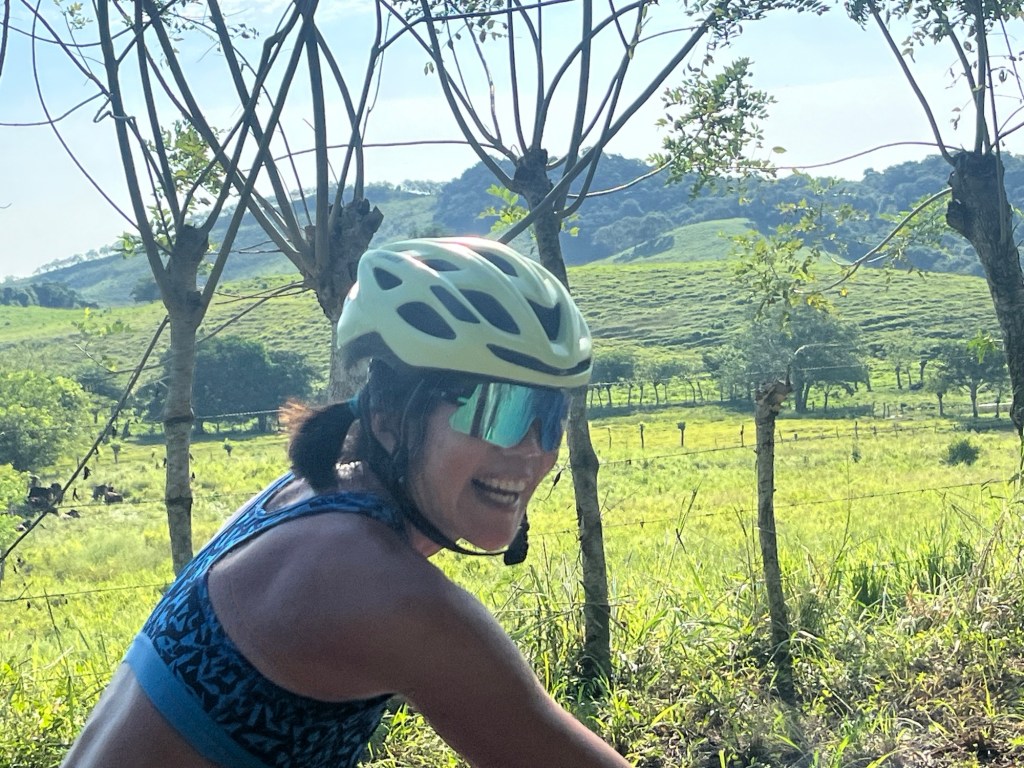


But don’t hit the snooze button yet. I’m not going to go on and on about the color of the sky or the majesty of the trees . . .
After a lot of biking through rural Mexico, what I want to talk about today is our impressions of farm life here.
The big thing: it feels like you are biking back in time. Where in the States we have big factory farms with huge combines that are run with precision by Elon Musk’s satélites, here it seems like it’s all small operations – run by men wearing cowboy hats and riding on horseback. (I’m cognizant of the gender distinction here – and I’m not trying to be sexist – but I don’t think we have seen a single woman involved in these ventures.)
From what we can discern, your average farm (rancho?) operation here is pretty small. Not sure on acreage – enough to graze some cattle – but my impression is that we are not talking about 1,000+ acre holdings . . .
A few floppy eared cattle, definitely some chickens running around randomly, at least a few dogs – which canines may or may not have names, definitely don’t have collars or anything, and are certainly not fixed in any way – maybe a pig or two, and some horses or donkeys.
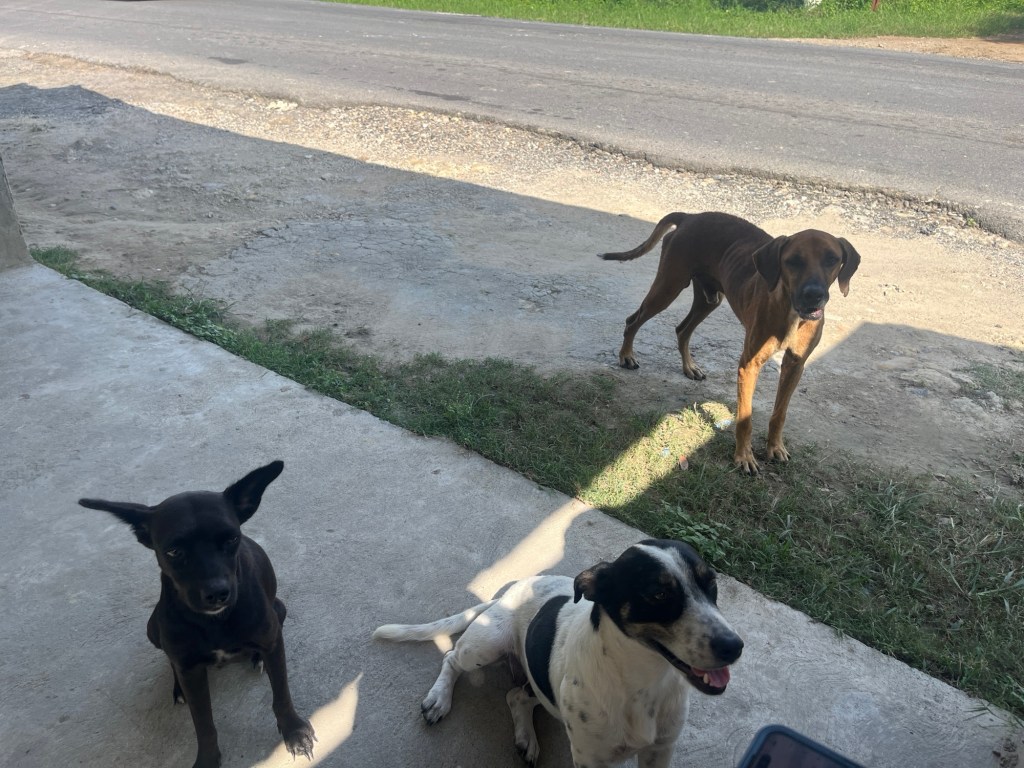
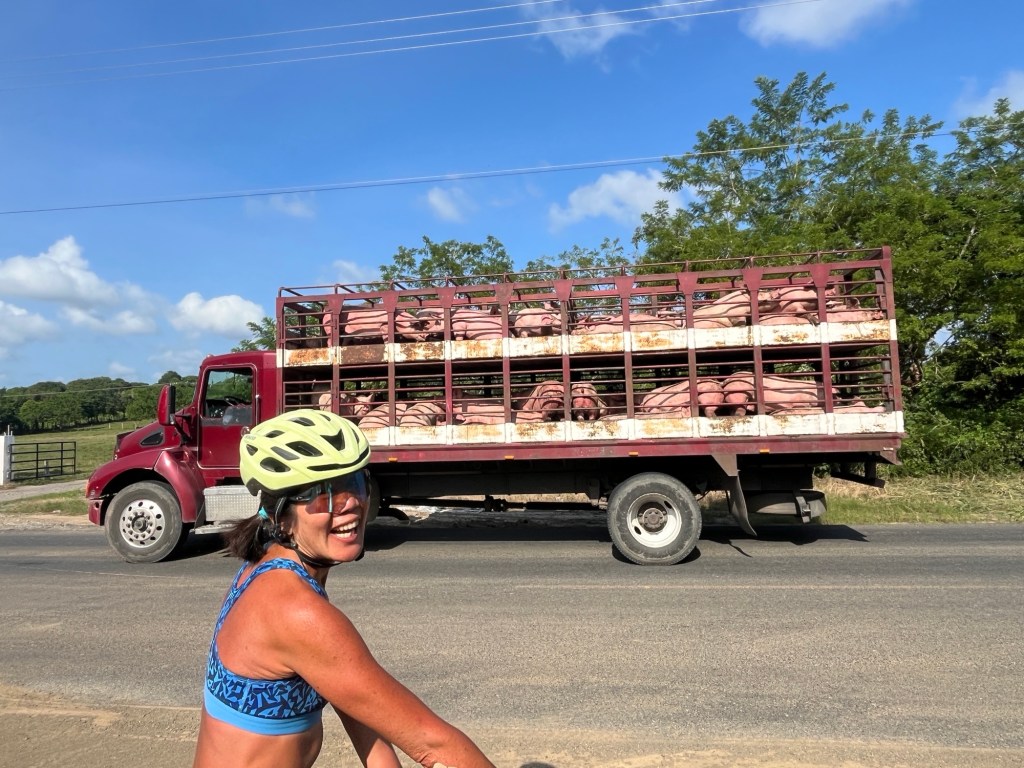
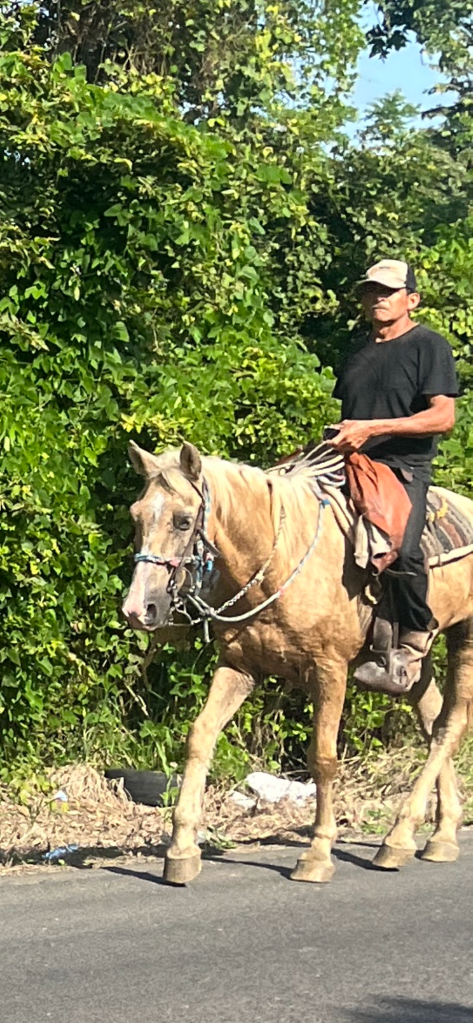
For the past several hundred miles now we’ve been getting used to various farm animals placed on a rope for the day, next to – or even in – the road. Lots of horses like this. They can kind of surprise you: you’re riding down a quiet road, not paying much attention – and all of a sudden a horse or a donkey or a cow is popping out of the woods. It can be a little disconcerting . . .

I had been wondering what people did with all the horses. But after today – seeing a lot of men riding around, apparently set on managing the cattle – I think that these horses are to Mexican farmers what ATVs and pickup trucks are to their American counterparts.
On this general topic, I had been wondering why we hadn’t seen any beekeeping operations. We’ve seen the honey – and especially in this super verdant area there are certainly enough flowering plants to support a few colonies.
As we rode today I happened to spy some hives in the jungle beside the road (one can no longer say “the woods” – it’s just too dense). I took a quick picture and video.

It was kind of funny. No effort to level an area for the hives or place them in any kind of organized fashion. Just throw the boxes in the woods. Generally in Minnesota we try to have some southern sun exposure for the bees – gets them working in the mornings and keeps them warmer in the winter. I guess down here the bigger concern is having the hives get too hot – thus the shaded jungle location . . .
Not that beekeeping is ever that high-tech, but this operation seemed to fit with the general low-tech, low-investment, but labor intensive way that the Mexico agriculture scene rolls.
One other somewhat related example of all this . . . There seem to be very few lawn mowers in Mexico. We’ve seen people “mowing” huge lawns with weed whackers. Can’t imagine Americans ever doing this. Worse, you know the 20’ or so wide strip beside the highway. Goes on for miles. Haven’t seen a motorized cutting mechanism yet. Guys are literally hacking this stuff away with scythes and machetes. (There are A LOT of machetes in Mexico). In the heat, in the middle of the day. Again, can’t imagine doing that.
“Okay, team, there’s three of us. We’re going to take a scythe to this vegetation growing on the side of the road here.”
”Umm, how far are we going?”
”Well, Carlos, this shoulder goes on for the next 47 kilometers. I expect we’ll get through half-a-kilometer today . . .”
It’s crazy.
And what an opportunity for Toro. If I ran the company I think I would give some loaner mowers to Mexico for a year. Once you took them back the workers would have a mutiny and Mexico would be forced to buy some real cutting machines of their own . . .
But that’s just a small-scale scheme.
Here’s my big idea for the day:
Last year we encountered lots of Amish people up in Canada – north of Lake Huron – on our way to Toronto. They had apparently moved there because the land was cheap. But, talking to the locals, they didn’t always fit in . . . Canadian farmers, like their American counterparts, tend to use big combines. They have pickup trucks and they use modern farming methods. They told us that the Amish, with their horse and buggies, were not necessarily their favorites.
Well, what I’m thinking is that the land in Mexico is probably pretty cheap. And, unlike the Canadians, the Mexicans themselves use older farming methods. They use horses to herd and manage their cattle. You frequently see their animals on the roads. I just don’t think the Mexicans would be the least bit bothered by the horse and buggies or the general approach of the Amish.
The only problem? The Amish seem to rely upon the locals being willing to pay a premium for their goods because they think it’s quaint that the stuff is made by people who drive horse and buggies and dry their laundry on clothes lines.
I’m not so sure the Mexicans would be willing to pay such a premium. I don’t think they’d be impressed by the horses, the buggies, or the bonnets that the women wear.
Putting aside these cute theories, I will say that it is hard not to be impressed by the Mexican farmers. They seem to work their tails off. With their smaller farms there doesn’t seem to be any of the monoculture of places like Iowa and Southern Minnesota – where it’s just corn and soybeans for miles . . . And, other than the individuals and companies that own them, who wants big ag in the first place? I think pretty much everyone else agrees that it’s better to have a whole bunch of small holders.
Alright, enough of the abstract policy discussion. Like we’re going to go back to managing our farms with horses . . .
The other big event of the day . . . We landed in Tuxpam this afternoon – thinking that this was just a place to sleep on the way to Poza Rica, Papantla, and the ruins at El Tajin. What we were treated to instead was a full-fledged, amazing festival, complete with a parade, marching bands, music, fantastic ethnic food, and huge crowds – a big night of celebration leading up to the Day of the Dead. All right outside the door of the hotel.

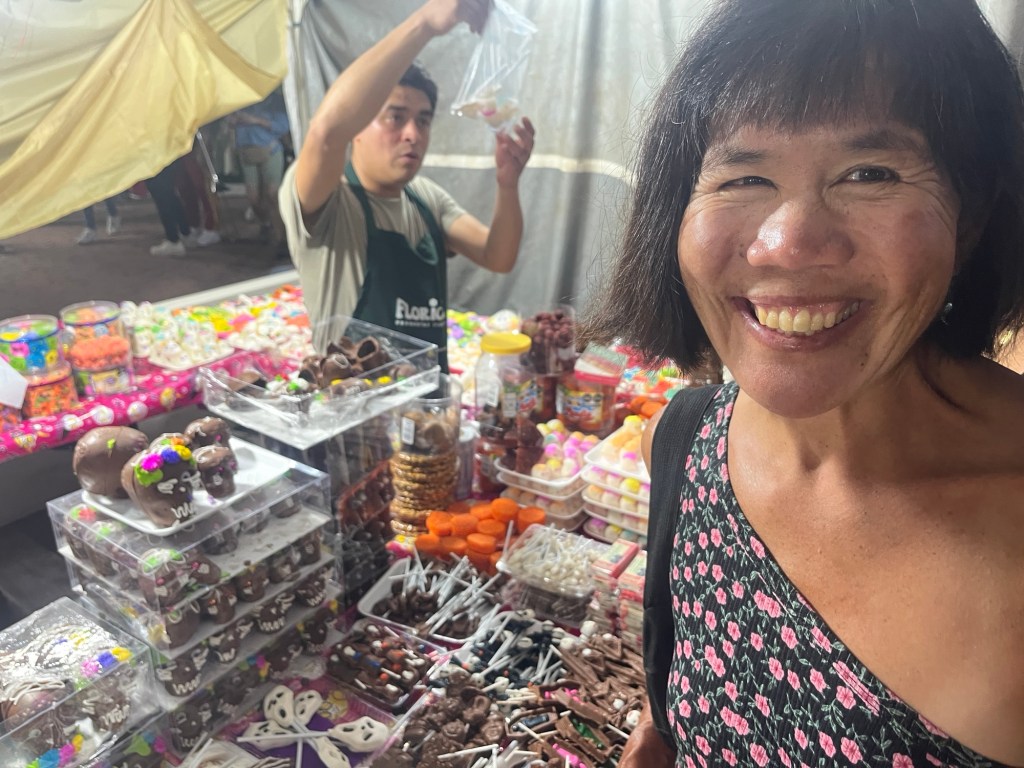

Last comment. Festivals like this really demonstrate the great parts of a community. High school marching bands. Small businesses. Entrepreneurship. Great cooking. And everyone seems so proud of the place they live. We have already been impressed by the generosity of the Mexicans. We came away from the festival tonight feeling like these are wonderful people – not the ridiculous caricature that some of our politicians paint . . .
Looking forward to Papantla, the ruins, and more Day of the Dead celebrating over the next few days. So fortunate to be here right now!
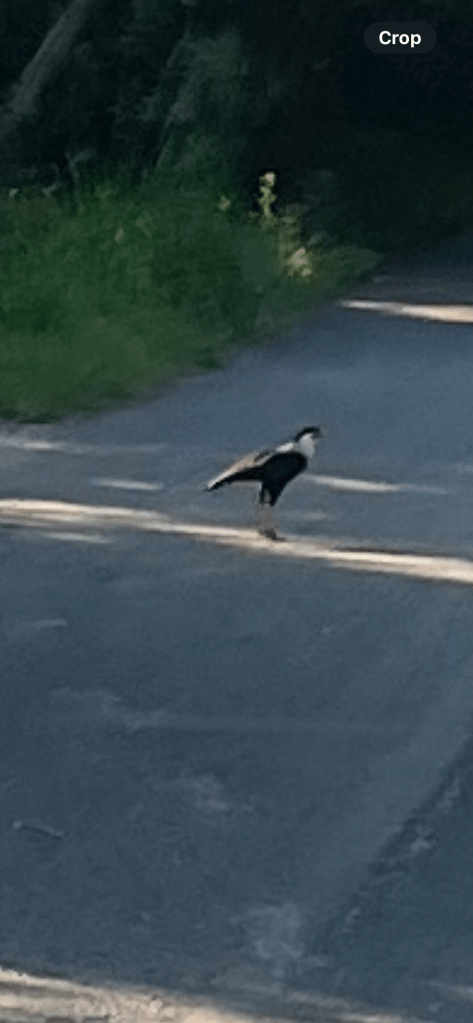


The birds at sunset . . .
Discover more from Diana & John's Biking Adventures
Subscribe to get the latest posts sent to your email.
 Diana & John's Biking Adventures
I’d be curious to know if those bees were Melipona bees, which have been cultivated(?) (husbanded) by the Maya people for centuries. I’m guessing there’s a method there. https://mayanmeliponabee.org/
LikeLike
I don’t know for sure, but these bees looked like pretty ordinary European honey bees to me. I didn’t know that the Mayans kept bees, but I guess they were a different variety. They were stingless and bigger than modern honey bees – which were bright to North America by the Europeans in 1620 or so. Good to know about the Mayan bees!
LikeLike
The key words are fortunate, joy, happiness… It is special for us to see the side of Mexico through your eyes, that only travelers on a bicycle can experience. Enjoy learning the culture and the simple joy of the people living and working there. John Filander
LikeLike
Exactly John. We are very fortunate in so many ways. One of them if having an opportunity to enjoy cultures and people this way…
LikeLike
Having learned to use a scythes I can tell you it probably faster and easier than carrying a gas powered weedwaker around.
LikeLike
Oh yes, definitely better than the weed wackers. Might not compare so favorably to a big lawn mower though ….
LikeLike
the bird sounds OMG
Laura B
LikeLike
So cool, right?!
LikeLike
Good roads with scenic views on the bike, excellent local food at a festival, and getting to see how people live their lives day to day-doesn’t get much better than that!
I don’t know about Mexico, but I do believe that in many areas of Central America and South America, there is quite a lot of monoculture type of farming, and a good majority of the crops get sold to the USA…big profits for the companies involved (as well as local gangs), but to the great misfortune of many of the locals. It is nice to see your on-the-ground point of view of the local lifestyle.
LikeLike
Yep. A pretty good day for sure. And as for the agriculture, I really have no idea. Just what I see as we ride…
LikeLike
John, I am so enjoying your blog. The La Squadra boys got together today for lunch at the Trailhead (during a Halloween snowfall) and you and Diana were the talk of gathering. Keep those photos and stories coming….it reminds me so much of our sabbatical to Ecuador, but your trip is much more daring!
keep the rubber side down! Mark
LikeLike
Good to hear from you Mark! Can’t imagine a snowfall now. Although it is raining crazy hard here right now… Looking forward to Evadir Ecuador!
LikeLike
We used to vacation down in Cancun and were always surprised to see the gardeners at these beautiful resorts cutting the lawns with giant scissors. I guess labor there is cheaper than paying for power tools.
Really enjoying reading about your adventures everyday, and it’s good to be able to tell that you guys are still alive and well!
-Ernie
LikeLike
Great to hear from you Ern. Scissors sounds about right. Would love to connect again soon
LikeLike