Kabakca – Pinarhisar, Turkiye – Malko Tornavo, Bulgaria
So I’ve been thinking about something kind of esoteric: the benefits of allowing yourself to need some help, or, put another way – allowing yourself to get in situations where you might need some help.
Munger – What in the world are you talking about?
Well, it’s occurred to me that on this trip many of the situations that have led to our most meaningful interactions with people have involved us needing some help. Maybe we need directions. Maybe we need some tinfoil. Maybe we need water. Burek. A place to stay. Doesn’t matter. The point is that when we need something and, because we need something, we are forced to ask for help – those are the times that we really connect with people.
And it works both ways. We need something, which causes us to start an interaction. But, the thing is, in general, people love to help. In fact, beyond loving to help – it seems to me that offering aid to others is a fundamental part of being human. So, the way I see it, when we need help, or put ourselves in situations where we might need some help – we’re actually doing our helpers a favor – by allowing them to satisfy their own basic human need: that is, to be part of the big web of humanity.
I guess this has really been a theme of my life. Turns out I’m pretty good at asking for help . . .
When I ran the Loppet Foundation, I never hesitated to ask. Maybe we needed people to shovel snow onto the trails. Maybe we needed help with marketing. Or legal matters. Or accounting. Or website work. Or a hundred other things. I always figured that I was doing people a favor by asking for their help; giving them a chance to get involved and to contribute in a positive way. Plus, if they didn’t want to help, they could always say no. (Which, by the way, rarely happened.)
Now, helping with a non-profit organization is maybe a little different than helping individuals like Diana and I. With the non-profit there’s the good cause. I guess it’s less obvious that Diana and I are, ourselves, a good cause. Maybe we are, but I guess I’ve always been a little more hesitant to ask for personal help. In the end, though, the same general principles apply: people want to help and they can always say no. And, again, people want and need to feel like they’re a part of this big web of humanity.
Let me share a few examples from the last few days . . .
We come into town and we’re looking for a bakery where we can get stuff for lunch. We could probably look it up on the phone, but half the time the little places we’re looking for don’t come up anyway – and, even if they did, using the phone is just a way to avoid a real human interaction. So we bring up Google Translate and type in: “Are there any bakeries around here?” Of course, we’re never quite sure what Google spits out for them to read (in Turkish , or whatever language we’ve landed on that day). It may be that the translation is bringing up something like: “You look like a fish and your mother is ugly.” But, so far, it seems like it works pretty well; no one has punched us in the nose or anything . . .
Anyway, we show the translation to two old guys who are having tea on the front patio of a coffee shop type place.
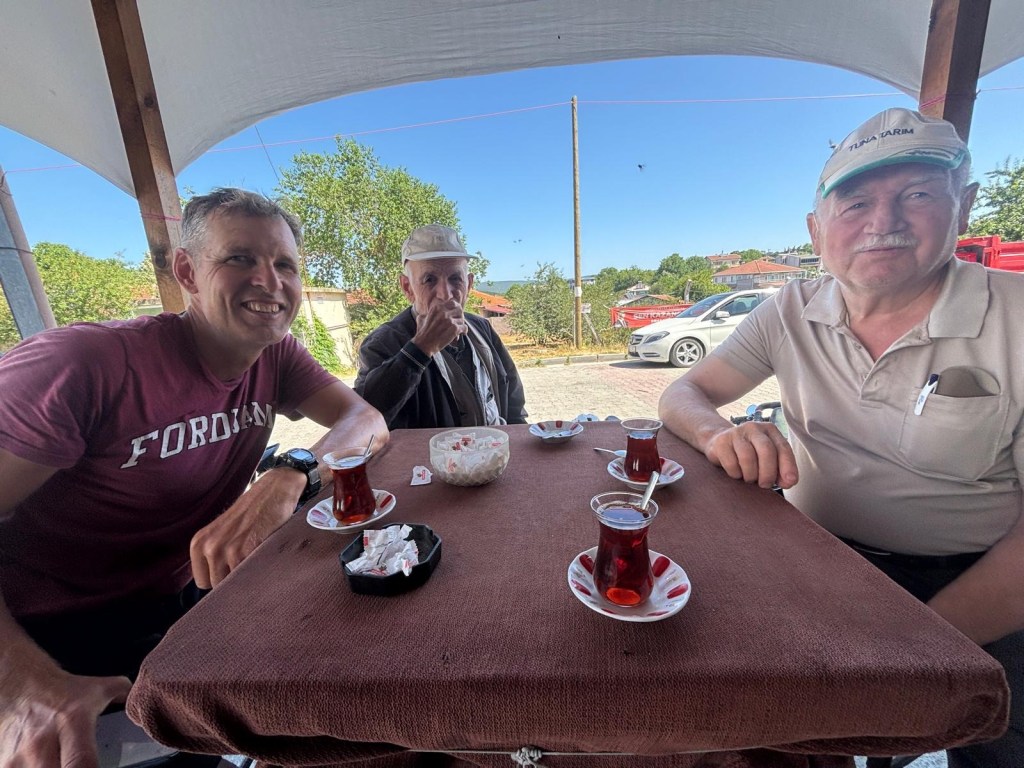
They say many things, very congenially I might add. But we don’t really understand any of it until they point to a little nearby store. We go into the store and there are a few loaves of bread, but nothing we would really call a bakery. After conferring a bit, we head back to the bikes.
But when we come back out of the store, the two old guys are waiting for us – only now there are four cups of tea on the table, and they are beckoning us to join them. We end up having two rounds of tea and a little bit of a conversation with one of them. (Mahmetta and friend are pretty old so the subtleties of Google Translate are a little lost on them).
Mahmetta has two dogs and he hunts rabbits. He makes things like rabbit stew, but also rabbit burek. Once burek comes up, we ask if there is any burek in this town. “No, but there is in five (five fingers) kilometers up the road.” The other big communication: the non-verbal idea that we are enjoying each other’s company. In the end, a great connection.
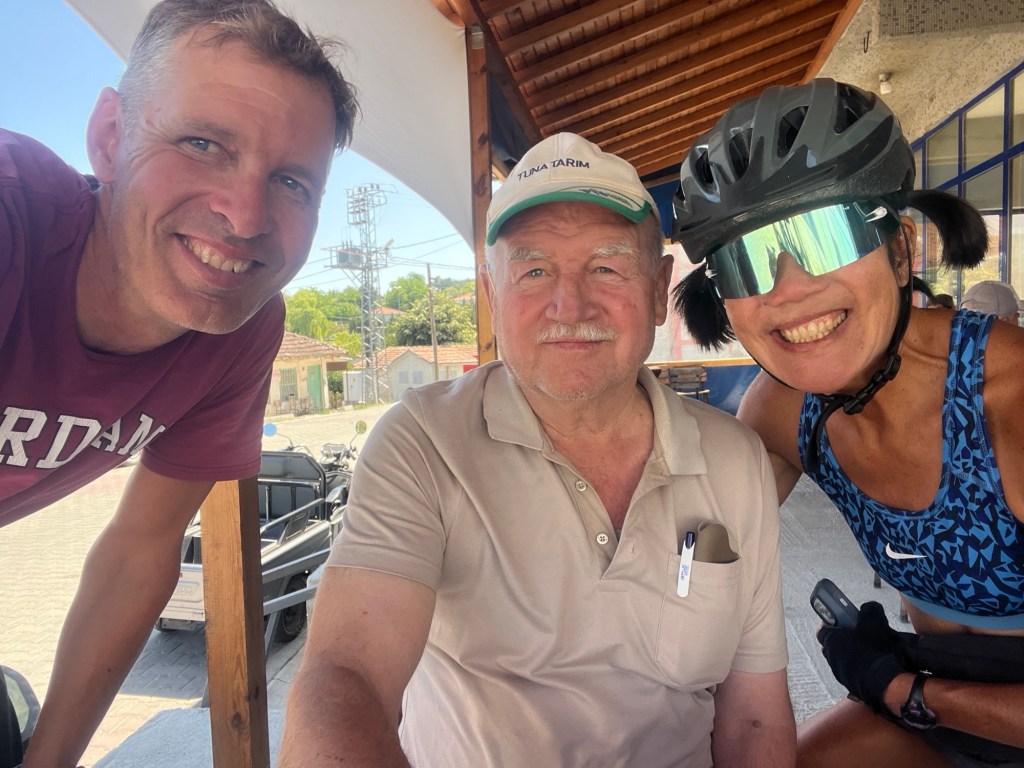
Which never would have happened if we hadn’t asked for a little help.
Okay, now it’s much later in the afternoon and it’s super hot. Apparently there is a little bit of a heat wave in Europe right now – and we’re feeling it for sure.
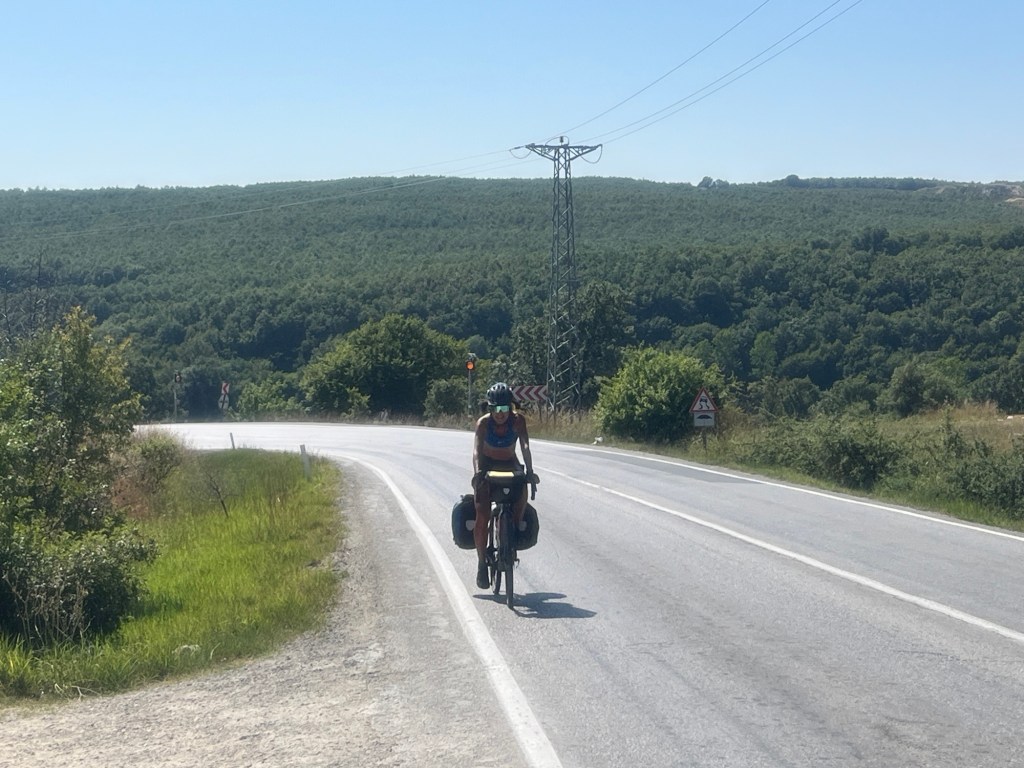
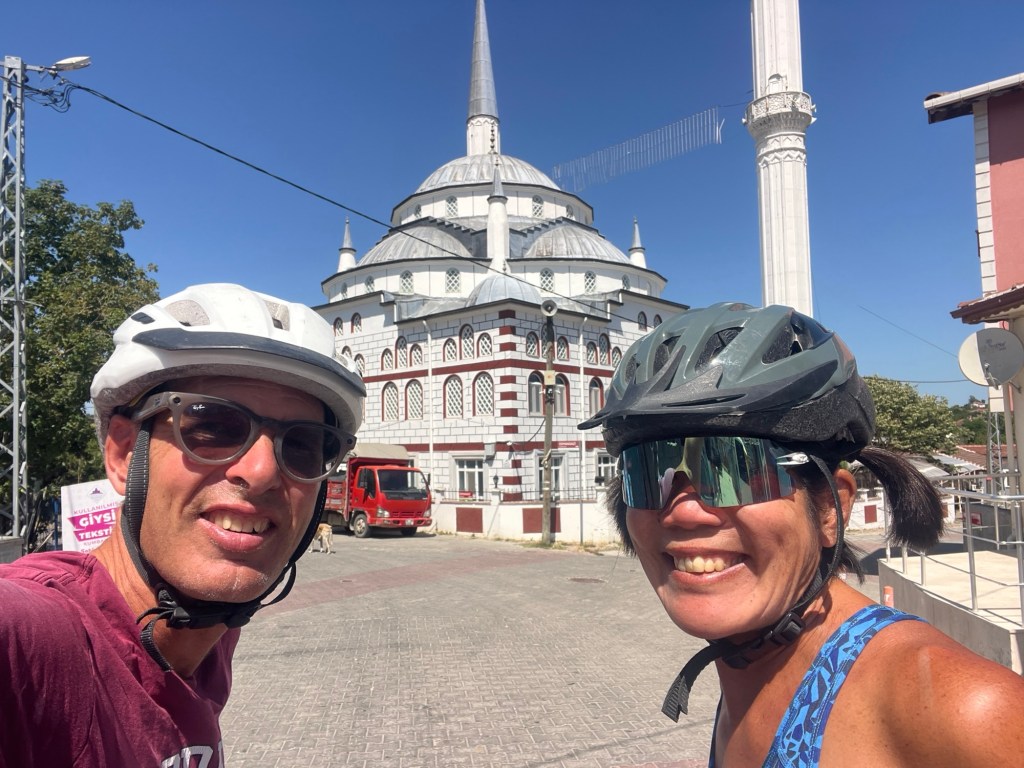
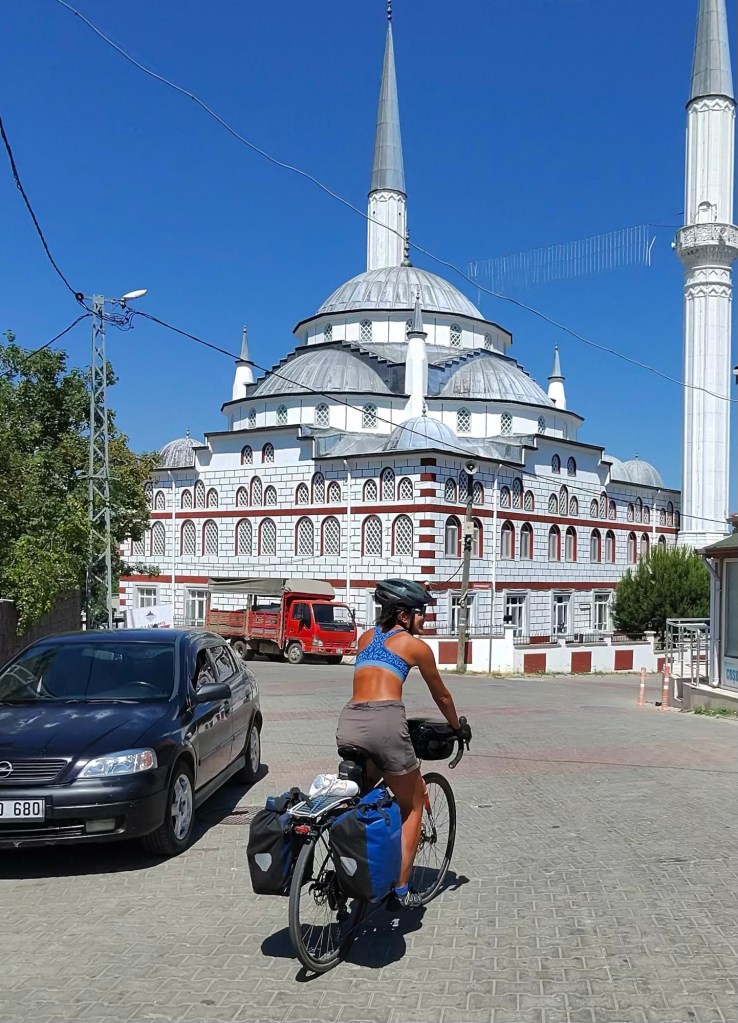
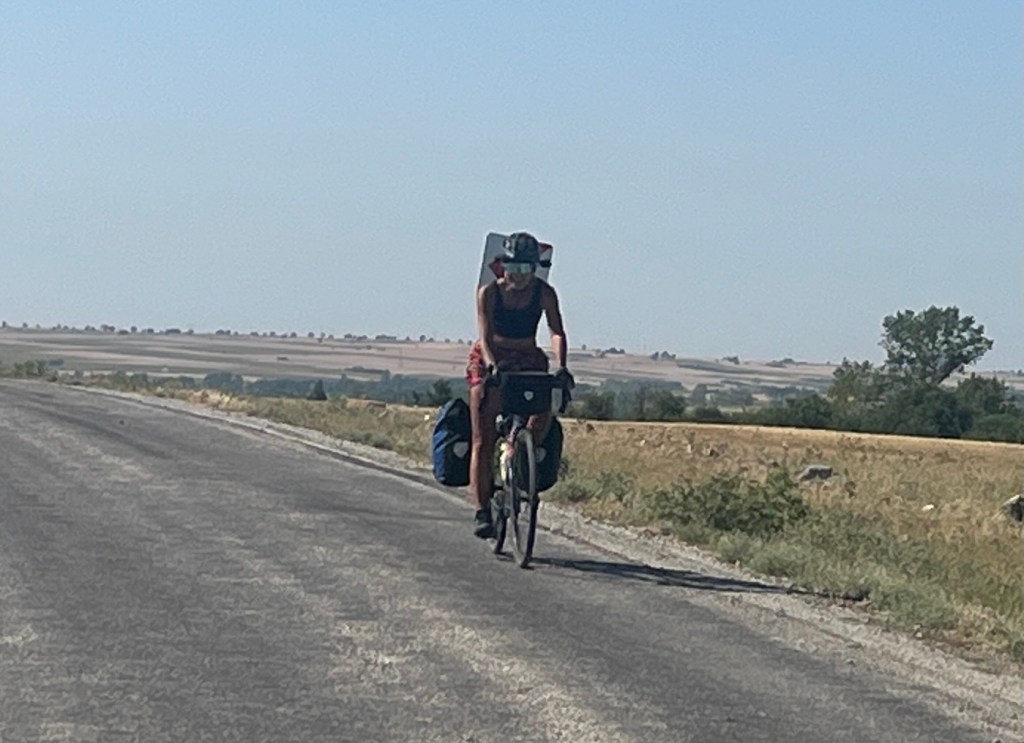
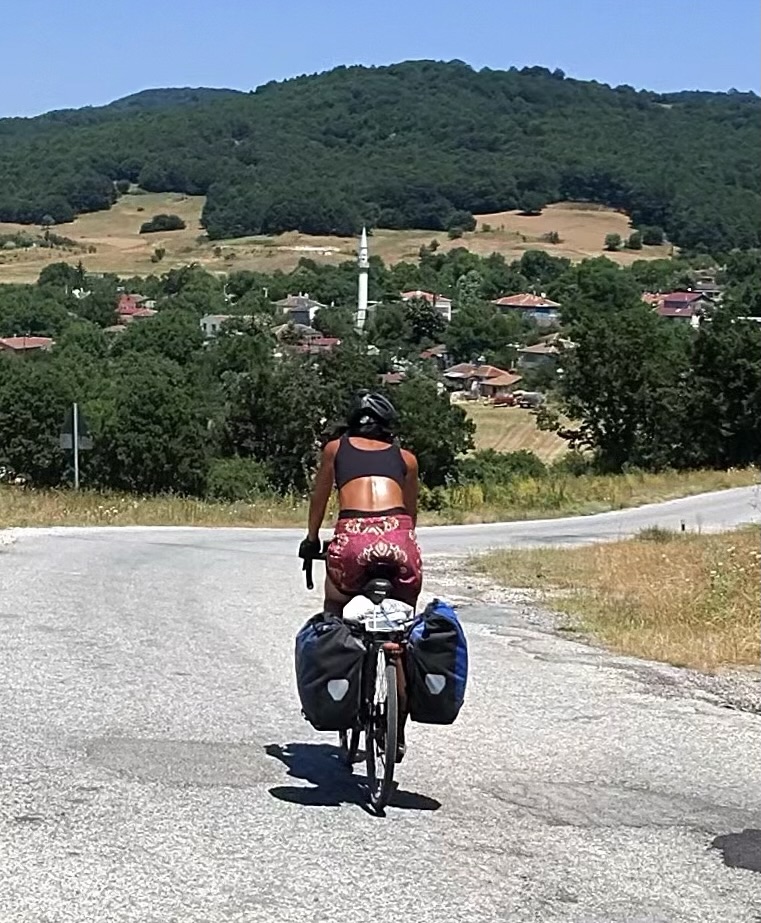
We’re biking along in the blazing sun – and I guess we look pretty overheated. We’re probably all red, and it’s not like there are a lot of people biking around here – so I think people in this part of Turkiye must have a particular appreciation for cyclists when they do see them.
As we’re going, I happen to see a guy on a motorcycle pull off the road carrying a water bottle. I think he’s probably going to one of the many roadside springs, but, really, I don’t devote any brain power to this question. Just something I happen to see . . .
A minute or two later, we’re heading down a big hill. It’s pretty steep and long, and we’re probably going about 25 miles per hour. I look up, and there, next to me, is the same guy – i.e., the water bottle guy – on the motorcycle. And, yes, he still has his water bottle. He’s holding it out to me and saying something – which, of course, I don’t understand, and it’s not like I’m going to use Google Translate while I’m riding at 25 miles per hour down the road.
I’m able to glean that he wants to give me the bottle of water. At first I gesture ahead to Diana and try to tell him to give the water to her because she is really hot. Then I realize that communication like that is never going to happen. Better just to take the bottle . . .
I keep my right hand on the handlebar and my eyes on the road, but I stick out my left hand toward the motorcycle. As we zoom down the hill, he puts the water bottle in my outstretched hand. Then he gestures that I should pour the cold water over my head. That’s way too complicated of a maneuver while I’m biking – so I resolve to stop Diana when I can.
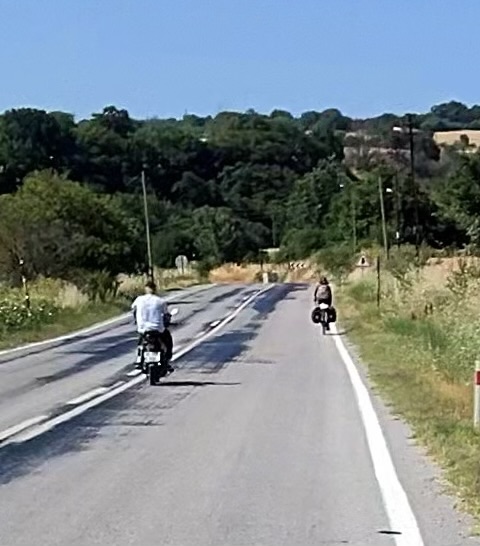
I catch her at the bottom, we stop, and down the whole 1.5 liter bottle of cold water in about 30 seconds.
Seriously helpful!
Now, we didn’t ask for help here. But I think it’s fair to say that we put ourselves into a situation where it was obvious that we could use a little aid.
Why do I say that it was so obvious? Because literally five minutes later a guy pulls over on the side of the road – and waves us down. When I stop, he hands me not one, but two more cold 1.5 liter bottles of water.
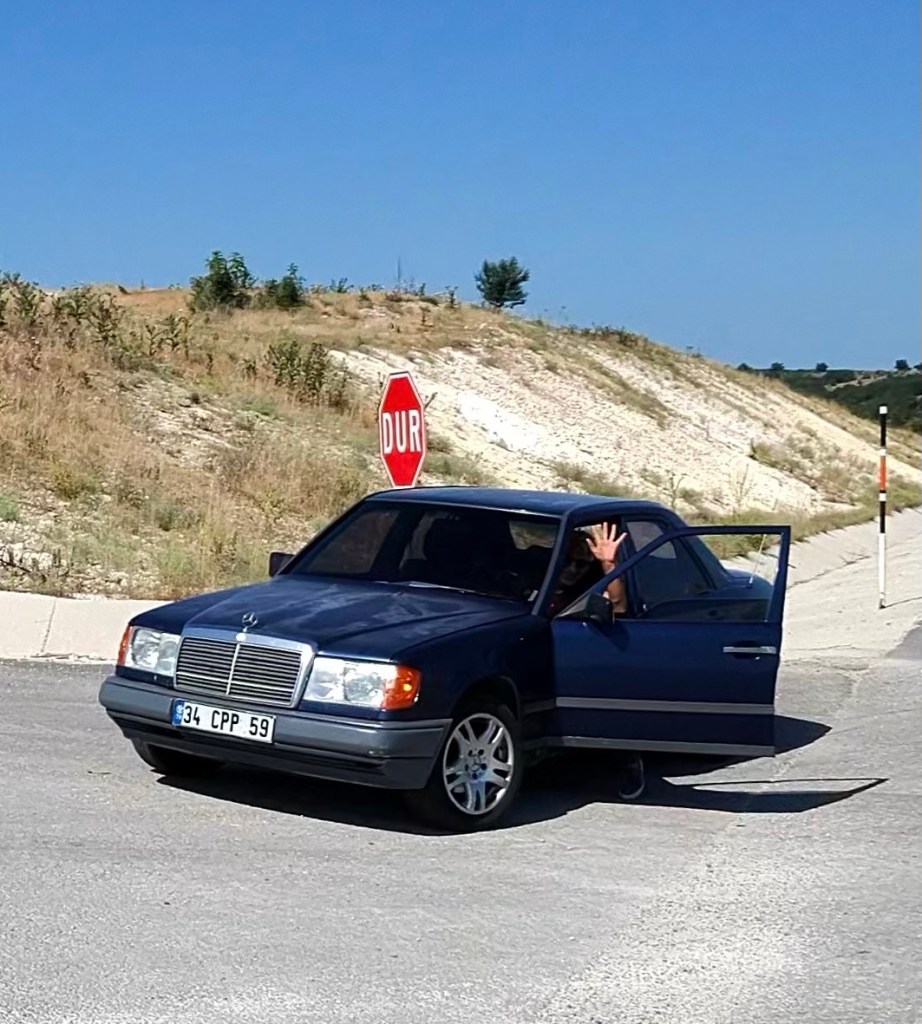
Are we wearing a sign that says: HELP US!?
I guess it’s obvious . . . Two foreigners biking along in a heat wave, who apparently look very hot . . .
Result: Two more really positive, if short-lived, connections.
And that was just yesterday . . .
It actually happened again this morning.
Within ten minutes of starting our ride we’re biking along, and we’re going past a parked car. As we pass, out of the corner of my eye I notice a hand protruding out of the driver’s window with a water pouch. I quickly pull over, and, once again, someone is giving me water. This time four pouches.
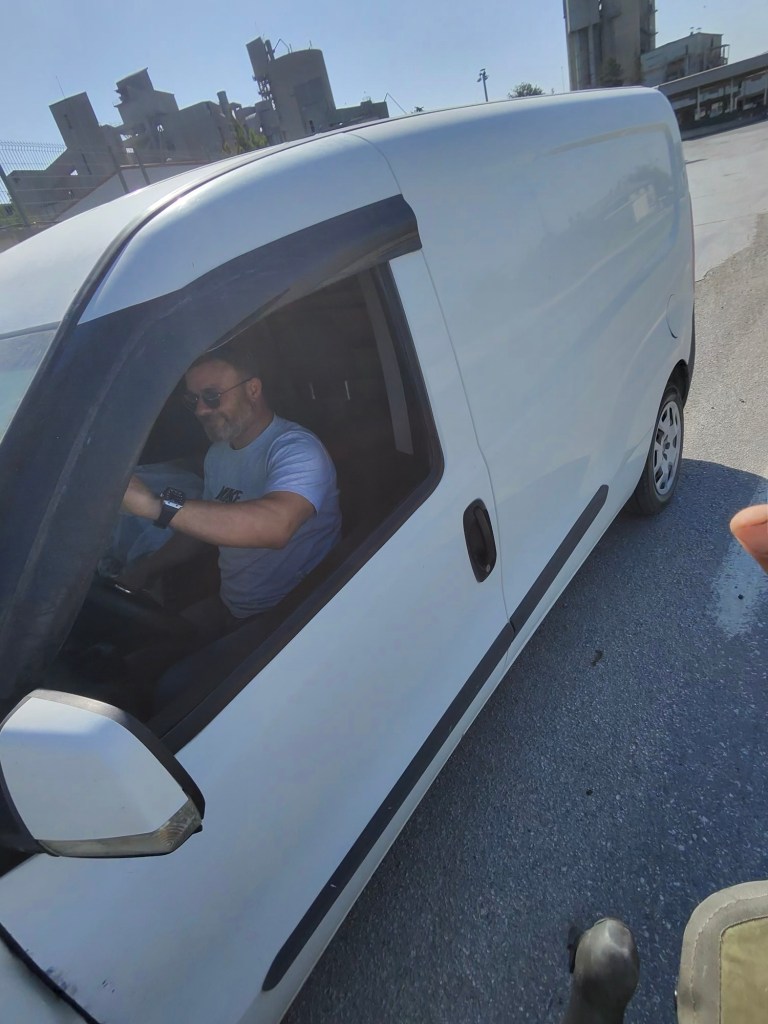
After three encounters like this in short order, I think it’s fair to say that, objectively, it looks like we could use some help . . .
Lots of morals of these stories . . . One, Turkish people just seem to be so generous and kind. Two, asking or needing help tends to promote more iteractions. And, three, it’s pretty fun to meet people like this.
Now, I think there are many of us who are afraid to ask for, or to need, help. I guess it’s pride. Or a sense that it is a sign of weakness to need help of any kind. But I think that attitude is kind of a bummer. Prevents us from connecting with some pretty great people . . . And deprives those people of an opportunity to make their own day better . . .
Okay, enough philosophy.
Three other things I wanted to cover today . . . Recap Erdogan, Bulgaria, and our ride today.
One of our readers suggested that we do a little more research on Erdogan – Türkiye’s current president. Turns out he’s more of a yucky figure than I really understood. First off, I thought he had only been in power since 2014 – when he was first elected president. In reality, he’s been in office since 2001 – when he was first became prime minister. Twenty-four years, and counting. That’s a long time.
His management of the economy has been pretty mixed. Seems like some growth for sure – but at this point there is something like 60% inflation! Crazy!
Then, I guess he, or his minions, have been arresting members of the press if they dare to criticize Erdogan or his regime. He seems to think going back to an Ottoman style regime – with expansionist ideas, might be a good idea. He also seems to favor a more conservative Islamist slant on religion rather than the secular view that Turkiye has had since Ataturk led them to independence a hundred years ago. Oh, and he is apparently against gay rights, and seems to be doing his best to move Turkiye toward a more authoritarian style government. He keeps winning elections, but that, undoubtedly, has a lot to do with the fact that he has rigged television air time so he literally gets about ten times the coverage of his opponent.
I know, I know . . . Many of you are thinking that this all sounds familiar. And I guess it should. Even the electoral map is similar; all the rural areas support Erdogan, all the urban areas support the opposition. There are even immigration issues – just like in the U.S. In Turkiye, the big immigrant pool is from Syria. I guess the thought was that they would all go home after Assad was ousted; but so far that hasn’t happened in any real numbers.
All I can say is that, like in the U.S., I hope Erdogan doesn’t destroy what otherwise seems to be a thriving democracy with a sensible separation between church and state. Hopefully the pendulum starts swinging back in the other direction soon . . . Both in Turkiye and around the world.
Bulgaria.
It’s amazing the impact a little mountain range can have.
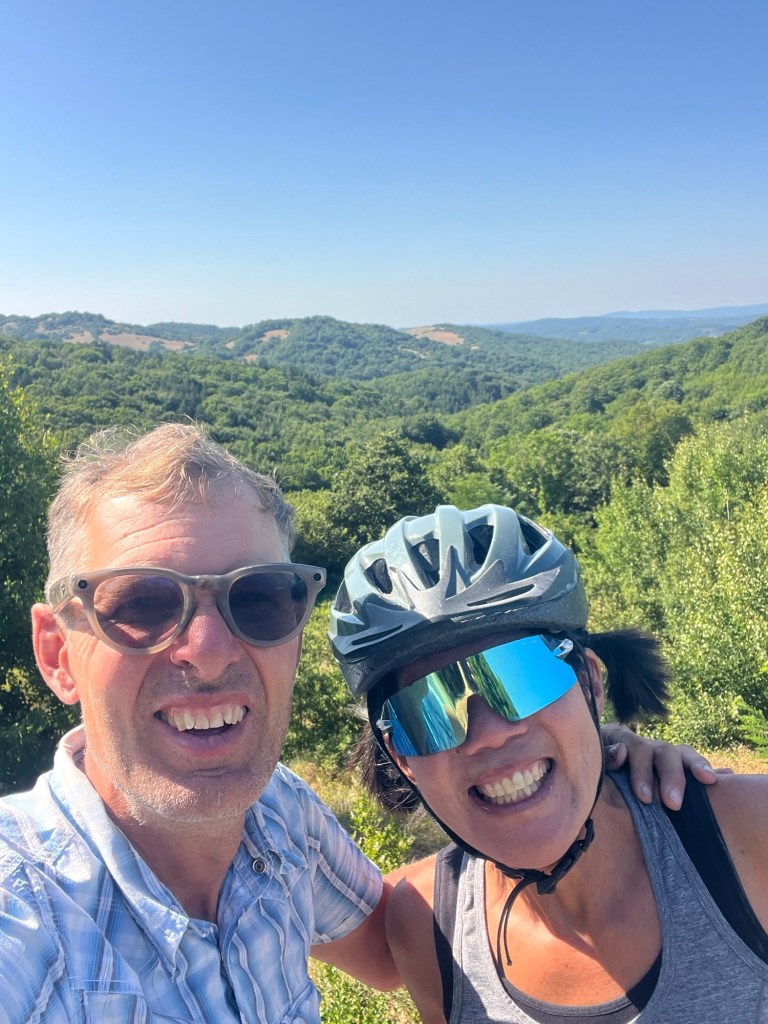
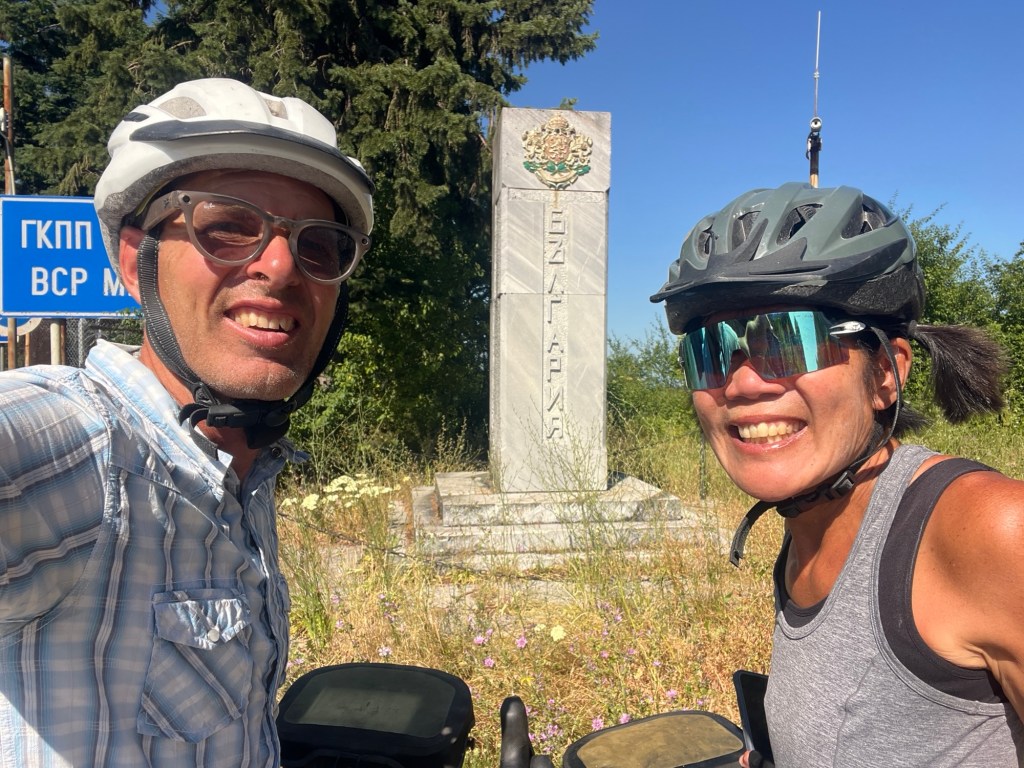
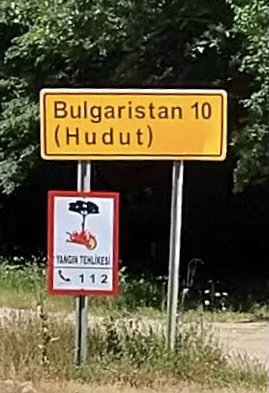
We went over a pass to go from Turkiye to Bulgaria today – probably 2,000 feet. Not much of a barrier – but enough to mean a completely different people, speaking a completely different language, using a completely different alphabet, and with a much different economy. Mostly different religions as well; Bulgaria is about 70% Eastern Orthodox, with only about 10% Muslim – I guess a vestige of Ottoman rule.
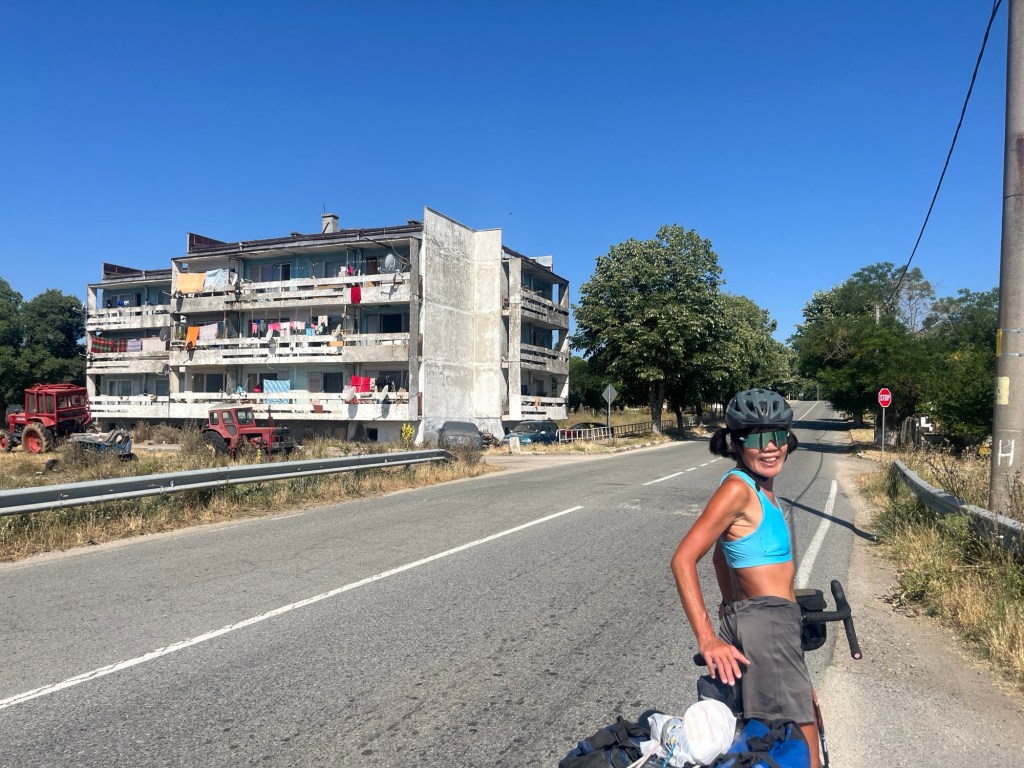
I guess Bulgaria’s GDP per person is a little higher than it is in Turkiye, but, based on the few hours we’ve been here so far and the one town we’ve visited, it sure doesn’t feel like it. Soviet era apartment buildings moldering away. Old cars still choking along. Streets in disrepair. Houses that look like they haven’t had any meaningful investment or repair – or even a coat of paint – in fifty or sixty years. Maybe our perspective will change once we’ve been here a few days – but so far it just doesn’t feel like a dynamic place. Not the way Turkiye does.
One more little Bulgarianism . . . Turned out we couldn’t find our Airbnb – or, rather, Google Maps couldn’t find it. We asked some people in the town square (more neediness on our part), and after quite a bit of debate among the townfolk, Dr. Nefario led us to the place on his little electric scooter.
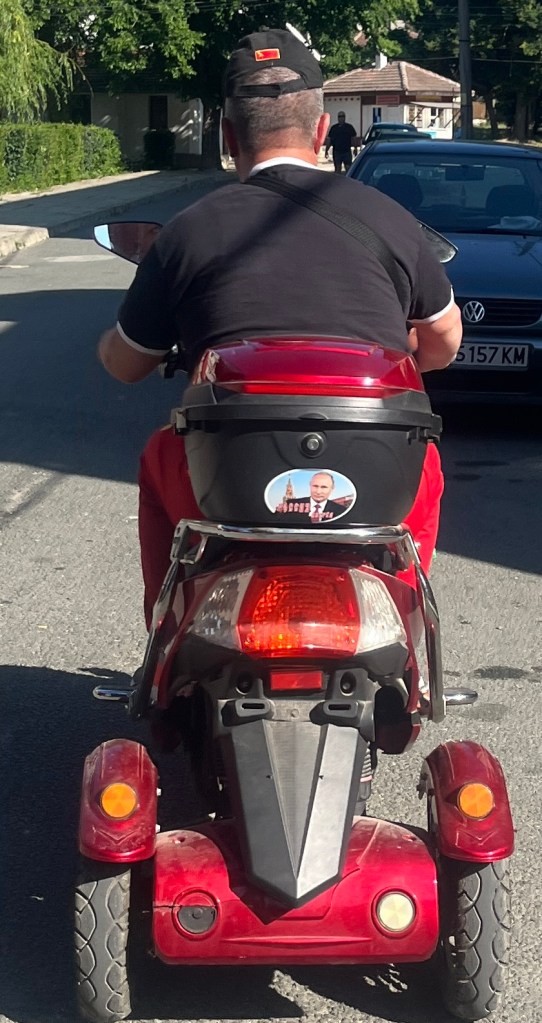
The interesting thing was that he had a Putin sticker on the back of the scooter, and he was wearing an CCCP (Soviet Union) baseball cap. We don’t have a common language other than hand gestures – but I asked him about Putin in the same way people routinely ask us about Trump. His response: a thumbs up. I can’t give you any subteleties here because that was the full extent of our discussion, but apparently he thinks Putin is doing some good in the world . . .
The riding.
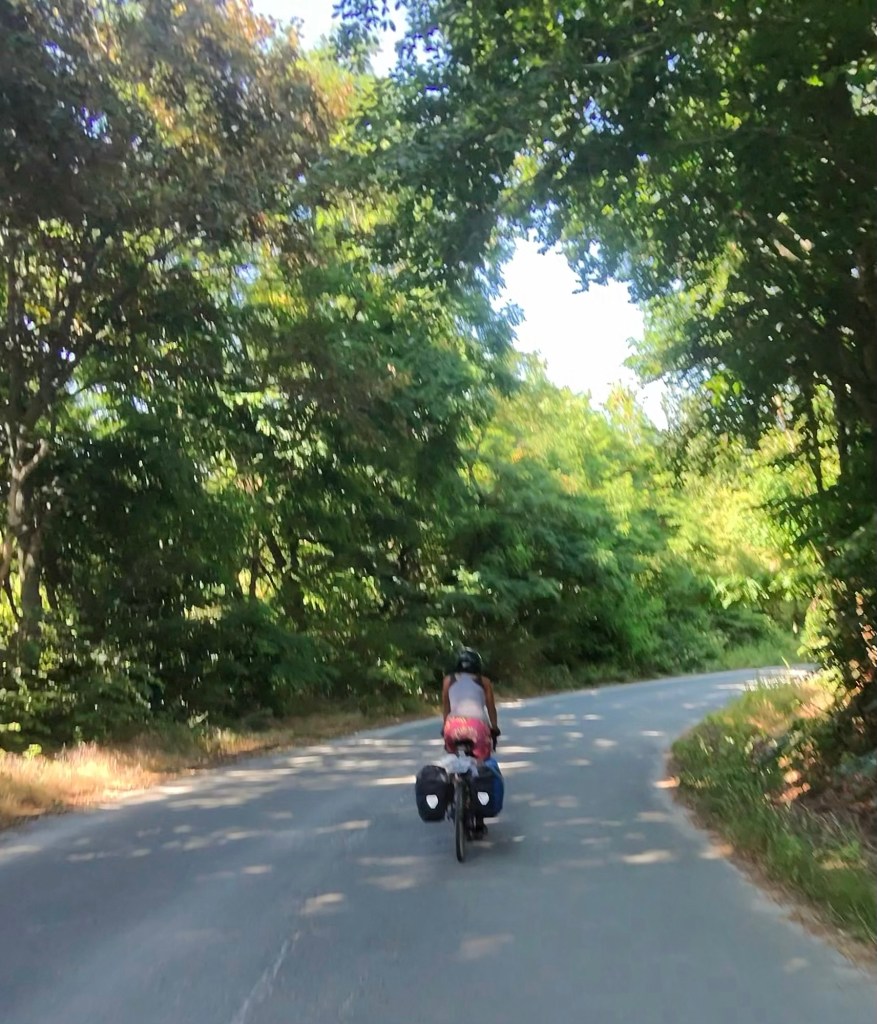
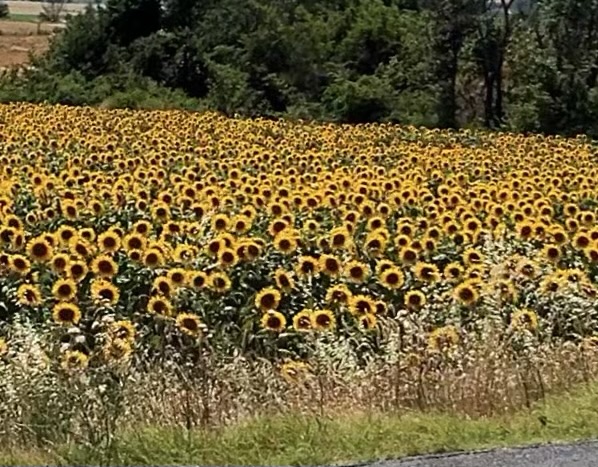
It’s like we went from Northern Wisconsin to Turkiye and back again – a few times – and within the space of 50 miles.
Which makes for great, interesting, riding. But confusing. One minute you are in the woods – with ferns and pine trees and dense undergrowth,
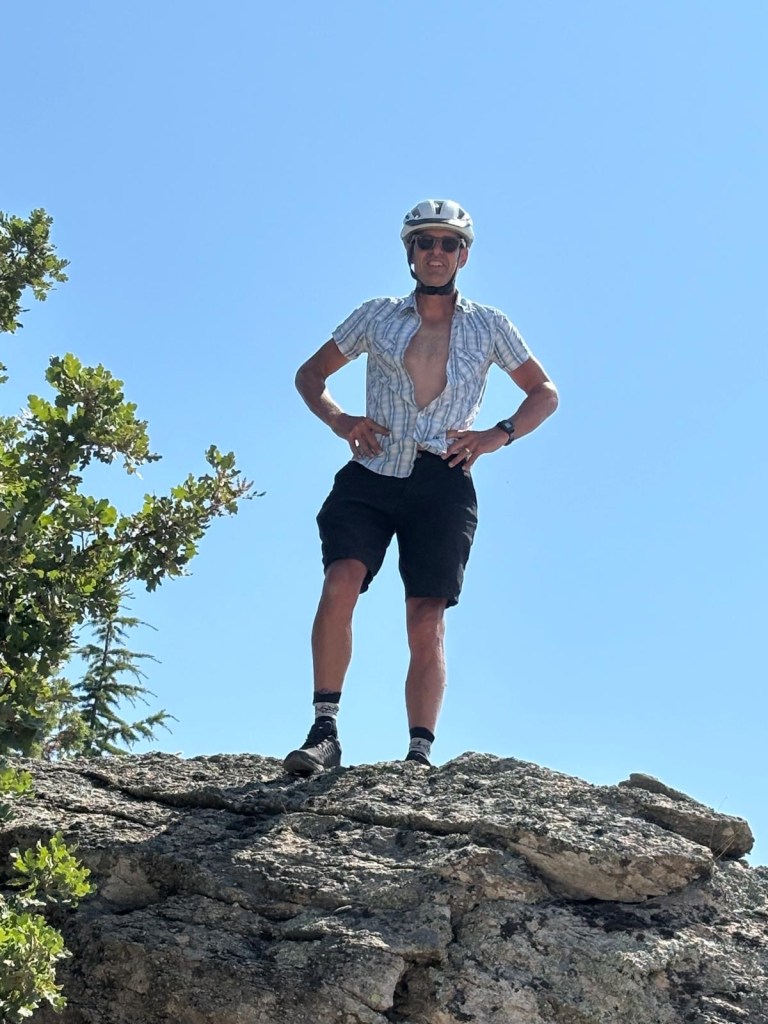
the next climbing a rocky semi-arid mountain,
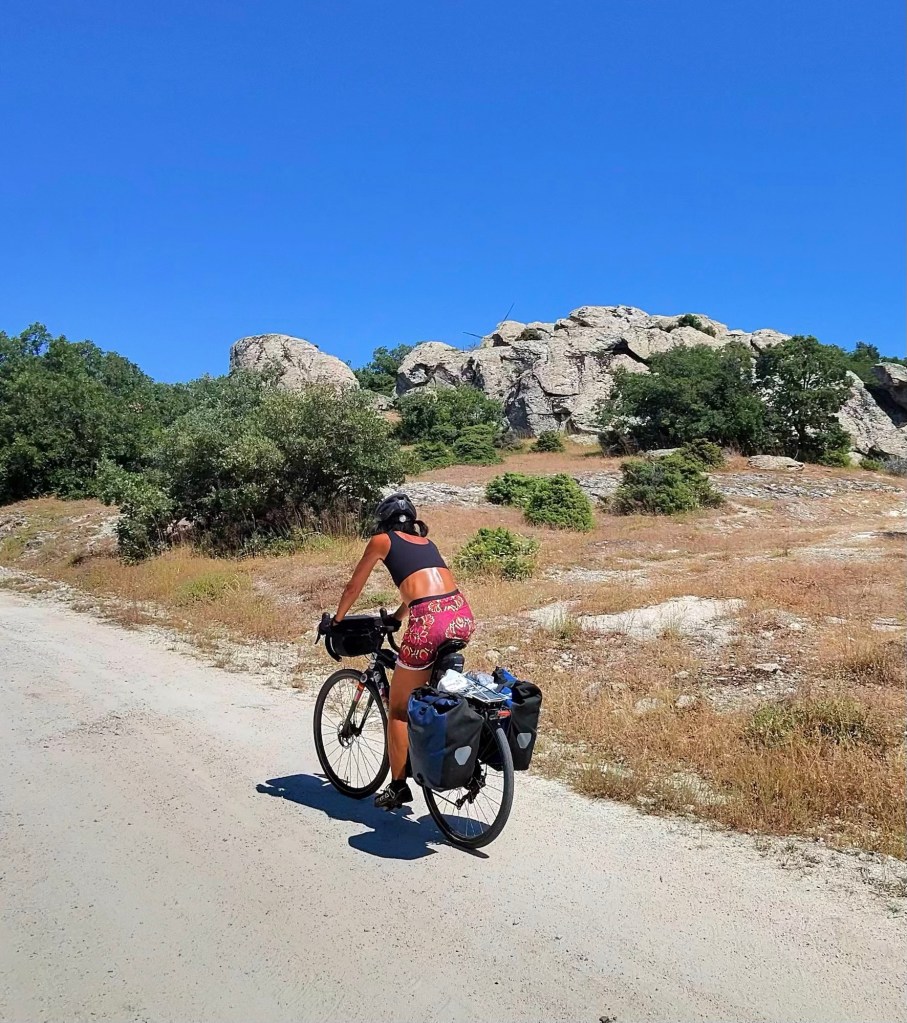
with wind turbines all over the place.
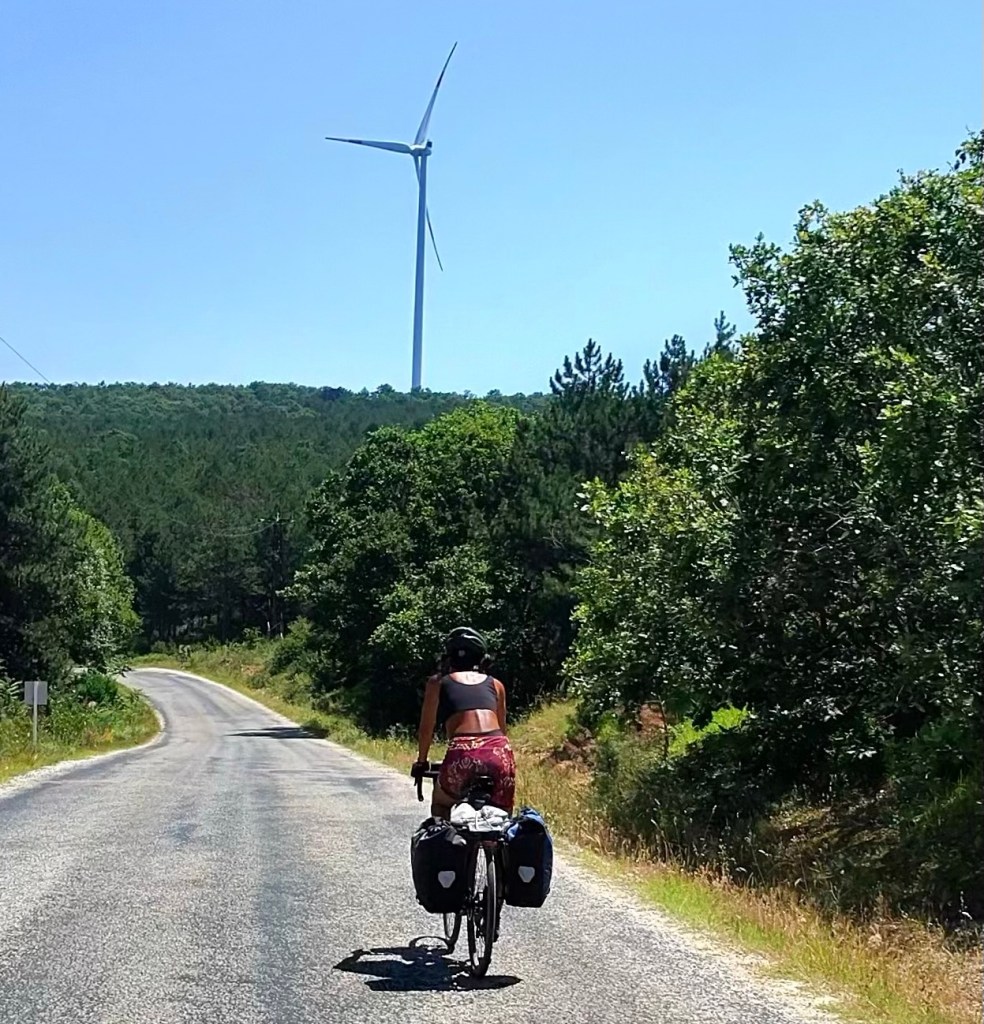
Tomorrow we head to Burgas, a beach town on the Black Sea. Should be fun. And interesting. I mean the Black Sea is kind of in the middle of all the action in the world. Countries that border on the Sea include: Bulgaria, Romania, Ukraine, Russia, Georgia, and Turkiye. And did you know that the Black Sea is about five times as big as Lake Superior? That is one big body of water!
Then we head on to Bucharest in Romania. After that we’re thinking about following the Danube along the Bulgaria/Romania border to Belgrade in Serbia. Anyone have any ideas on that?
Oh – you want the final results of the Great Baklava Contest? Turkiye did manage to make one final run at the crown. I spotted a baklava shop in some little town, and we stopped and bought six pieces. Total price: $3.50 – or about one-fifth of what they wanted in that highway-robbery place in Istanbul. That was a good start for sure – hard to like baklava when you paid for it like it’s made of gold . . . And it was good. Nice buttery flavor. Not a bunch of gummed up filo dough on top. But, alas, not as good as the Albania version – with that perfect mix of butter and honey and walnuts – with the filo dripping but still retaining some filo-ness. Mmm.
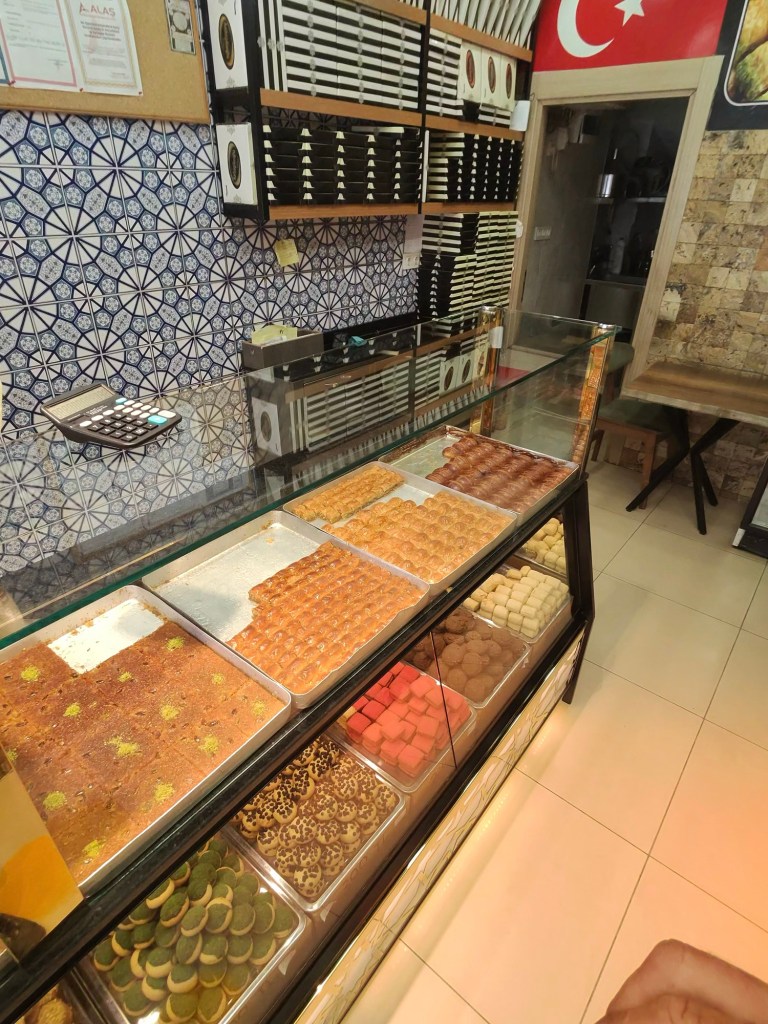
In the end, Turkiye gets an honorable mention. A respectable showing for sure . . . And Turkiye shouldn’t feel bad. It is so great on so many measures. Can’t imagine that it won’t end up in a good place in the years to come…



Discover more from Diana & John's Biking Adventures
Subscribe to get the latest posts sent to your email.


Asking someone for help gives them the opportunity to do good. E.g. hosting them for the Birkie, waxing their skis, fixing their bikes!
LikeLike
Hmm. Not sure I like the direction of this comment… 😁
LikeLike