Alexandria – Caracal, Romania
I think there’s a tendency to think that America doesn’t do enough to acknowledge its complicated history. And that is probably right. But, gosh, it’s not like we’re unique. Over the centuries, people have been pretty horrible to each other the world over.
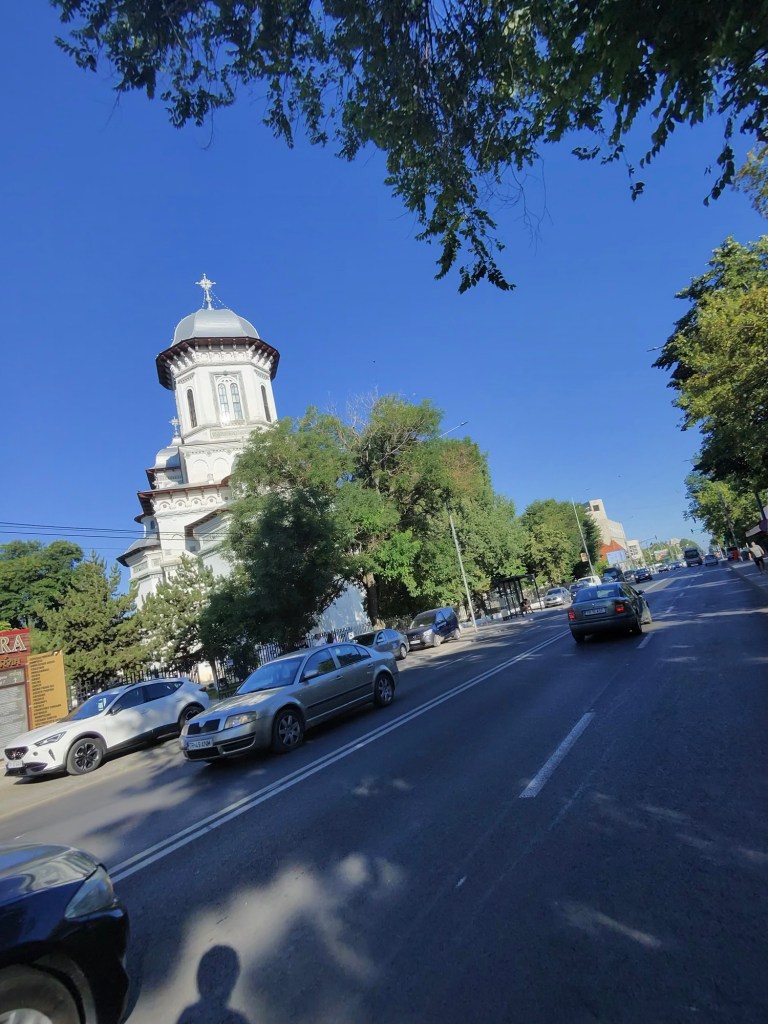
We rode through this really interesting town today: Buzescu. Apparently it’s a Roma town, and, since the revolution in 1989, the residents have been competing with each other to express their Roma culture in the most interesting ways.
We were impressed.
Which caused me to look up some Roma history in Romania. (Don’t be confused by the similar names. The Roma people are thought to have descended from migrants from India, and the name Roma or Romani, is thought to relate to the term “Dom” – the name of a caste in India. Romania is a Latin term and essentially means Roman . . .).

Roma history in Romania is not pretty. When the Roma showed up some six or seven hundred years ago, the Romanians enslaved them. Pretty much the same horrible treatment that American slaves suffered in America. And I guess this state-sanctioned horror continued until the 1850s.
From what I can tell, the Roma have been subjected to some pretty awful discrimination ever since. During World War II, Romania joined the Axis powers, and became a very ugly place. At the start of the war, before Germany attacked Russia, Germany and Russia divided up Eastern Europe and gave Romania significant control of areas outside of traditional Romania. Romania was a full-on participant in the Holocaust – with an estimated 280,000 – 380,000 Romanian Jews murdered. They also deported a number of their Roma population to a place in Ukraine that the Germans and Russians had put under Romanian control. While there was no systematic murder of the Romas, an estimated 11,000 to 20,000 of those that were deported ended up dying because the conditions were so terrible.
Horrible.
Now, we don’t know how much Romania grapples with this history, but I can say that, so far, we have not seen any signage or statues or other acknowledgement of all of this in our wanderings. Or, at least, we haven’t seen anything that we were able to recognize.
My sense is that it’s no wonder that Romania is still struggling. We all have heavy histories, but Romania’s history is really heavy.
Before I delved into all this ugliness, I was already planning to write about the Romanian psyche. Because, while individual Romanians seem nice enough, it feels a little like there is a generalized malaise in this country.
Diana commented that under Communism people were probably rewarded for not drawing attention to themselves – and it feels like that mindset has carried on, especially among older people. Small sample size, obviously – but people have not been saying hi, and very few passersby greet us, or cheer us on, or even acknowledge us in any way. Not a lot of unsolicited smiling. Just feels like a country that grimly plods along – resigned to a tough road to hoe . . .

Now I don’t want to make it sound like Romania is terrible. It’s not. There are some serious bright spots – it’s just feels like you have to work a little to get people to take their guards down . . .
Here are a few notable bright spots . . .
Baklava.
Normally I’m a pretty fierce traditionalist. If apple pie is good, why change it? Don’t put caramel in, or chocolate, or whatever. Just keep making apple pie.
(Note that this is a subject that can get me in trouble with my desert-making wife. She loves trying new things. I’m always like: “Umm, your key lime pie is great. Why add an orange?” Which generally gets me a response that goes something like this: “Well, you don’t have to eat it . . .” I mean, I’m just trying to be helpful . . .)
So I was a little skeptical when I saw that Romania had baklava with cherries on top. (I’ve never been a cherry-on-top kind of guy, either. Like those nuclear-red marichino cherries they put on top of malts. Yuck . . .). Nonetheless, in the spirit of accurate reporting, I sacrificed my own predilections for all of you – and bought a few pieces.
Upon closer inspection I was dismayed to find that the cherries were not just on top – they were also integrated into the baklava itself. This just seemed like complete sacrilege: taking the perfect food and then ruining it.
Not good.
Then I took a bite.

And another.
And another.
And I have to admit that these Romanians are on to something. They may have figured out how to actually defy an immutable law of physics: they improved on perfection.
Baklava with cherries. The new gold standard!
Move over Albania . . . There’s a new sheriff in town . . .

Grandma’s Pork Dinner with Polenta.
Something I ordered off the almost-incomprehensible menu last night. Almost like a goulash – with potatoes and carrots and stuff. Super good. One of the few meals that I have had on this trip that left me completely satisfied. A good mix of carbs and meat and veggies and taste. Turns out that isn’t easy to do.
Feeling pretty good about Romanian food – and, really, the food we have in front of us for a while. After all, one would expect the Hungarians to be pretty good at goulash – didn’t they invent it?
So I mentioned that it was getting hot around here. Our resident meteorologist – Dr. Liu – reports that it’s 99 degrees right now – in the shade.
But don’t feel sorry for us. We seem to have figured out how to deal with the heat.
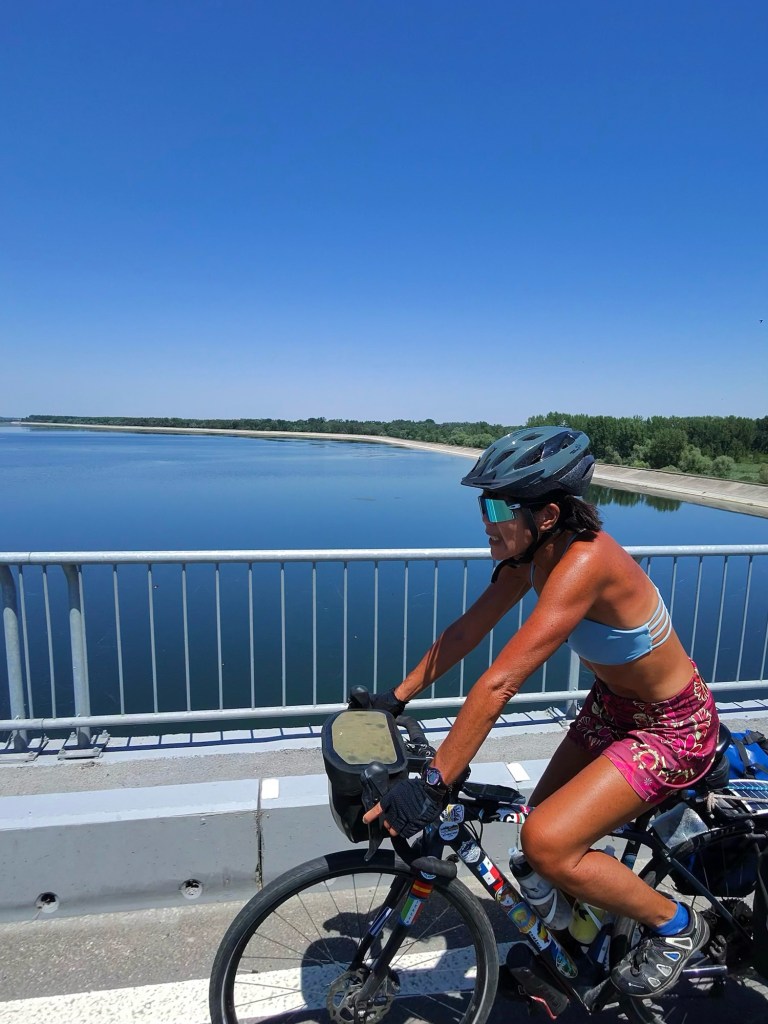
Our new strategy: Get up early – ride in the morning, when it’s a little bit cooler, don’t go as far, and then go directly to the town pool for the afternoon. I sit in the shade and read and write. Diana worships the sun, and does laps through the hordes of splash bombers. Everyone’s happy.

Two more hot days through the Romanian plains before we reach Serbia. Actually kind of hoping for some mountains – because, hopefully, it’s a bit cooler on top . . .
Alright – by popular demand, a new feature . . .
Gear Review.
At first I was thinking I would do a whole gear issue towards the end of the journey. But upon reflection I decided that would be too long and, potentially, boring.
No particular order to what we review . . .
Let’s start with our electronic devices. In my case, there are three main components: phone, IPad (and wireless keyboard), and Kindle.
I guess my headline here would be that, to do over again, I think I would ditch the IPad and Kindle, and, instead, buy a super-oversized phone. Always in the past we’ve done these trips with physical maps. I suppose it’s technically possible to still use paper, but as a practical matter those days are done. To work for biking, the physical maps have to be super big scale – which means that the maps end up super big. Which means that you can’t really carry all the maps with you. Which means that you have to buy them along the way.
Which we used to do. Twenty years ago you could buy good maps at gas stations and convenience stores. No longer. Good, big scale maps, are a serious specialty item. Meaning that unless you want to put tons of energy into the idea, they’re not reallly happening.
Upshot is that, like the rest of the world, we end up using our phones for navigation, for finding campgrounds, for finding hotels, for finding restaurants, for finding town pools, for finding grocery stores, etc.
But the thing is, tiny small screens kind of stink for navigation. Especially when you have old person eyes. By the time I blow the map up so I can read it there is absolutely no perspective left. Not good. So before our next trip I’ll be investing in a new phone – with the biggest possible screen.
And my sense is that this will be better for everything. Because with a big screen I could use the phone as my reading device, and as my writing device. I would still need a mobile Bluetooth keyboard, but that’s super simple. Losing the Kindle isn’t that big of a deal, but losing the IPad would be great. I mean it works fine – but it’s a lot of unnecessary weight.
Oh, on a related note, we have Verizon, but I have been using eSIM cards to connect. All good. Cheap and easy. But the problem is that I still want my regular phone number on my return. Verizon won’t let me just park the number – so they’ve been charging me every month – for essentially nothing. No obvious solution to this – but I think I might be able to port my phone number to Google Voice and then deal with it on our return. Only problem with that idea is that Google Voice is not available over here and, because of that, I can’t access their website until I return home. Aargh! Anyone have any thoughts or advice on this front?
That’s the news from poolside – where the people are Romanian, the tattoos are plentiful, and the natives smoke like chimneys . . .



Discover more from Diana & John's Biking Adventures
Subscribe to get the latest posts sent to your email.
 Diana & John's Biking Adventures
FYI – One does not hoe roads, one hoes rows – like a row in a garden or field.
LikeLiked by 1 person
Ha. Good point. Would be very difficult to hoe a road… 😁
LikeLike
How about using a phone app for Navigation (e.g. Komoot or Strava) or a dedicated bike compute that tells you when to turn. No need for an oversized smart phone dangling on your handle bar. They even come with different voices that yell at you -off course off course ! re-routing re-routing and beep and flash all the time – long 20km climb ahead !
Maybe you can downgrade your
Verizon to flip phone without data plan to keep your number. That for old seniors ?!?!?
LikeLiked by 1 person
You have much more faith in Komoot and company than I do. I always feel like I need to look at the screen to understand what they really want me to do. It’s like your hand signals when we’re biking together…😁
LikeLike