Cieszyn – Krakow, Poland
So far, Poland is one of the most interesting countries we’ve visited.
This is a country that has endured hundreds of years of toiling at the bottom of the European food chain. Subjugated and exploited by Lithuania, Russia, Austria, the Prussians, and the Germans, then suppressed by the Communists, Poland was more of a punching bag than a country.
Thus, the Polack jokes so many of us grew up with.
My personal experience with Poland has been pretty limited. Growing up, I guess I associated Poland with cleaning ladies. At the family motel in Duluth the cleaning lady was a Polish woman named Heidi. For years Heidi and her children were the primary housekeepers. Maybe I just extrapolated from there – but it seems like I’ve always thought of women emigrating from Poland and taking on jobs like that.
It wasn’t until college that these preconceived notions started to change. One of my best friends, Piotr Bednarski – there’s a Polish name for you – is the son of immigrants from Poland. His Dad was a super-smart, well-educated engineer type guy. I think they defected sometime in the ‘60s. So much for the cleaning lady stereotype . . .

Arriving in Poland now, it takes about five minutes to glean that this is not some backwards country. Gleaming modern cars. Sparkling houses, adorned with flowers, manicured lawns and gardens.

Well-kept roads. And just a general feeling of positivity in the air.
Indeed, Poland has made huge strides in its short history of independence. In 1990 – just after the yoke of Communism was finally lifted – the country had one of the worst economies in Europe – with massive unemployment and skyrocketing inflation. No wonder the world saw lots of Polish immigrants back then – ready to do anything to earn a living.
Today, Poland’s unemployment rate sits at 3%, and it is one of the biggest and fastest growing economies in the world. So many of the other former eastern bloc countries – countries like Bulgaria, Romania, Serbia, Bosnia, Albania and Montenegro – seem like they are still trying to figure it out.
Difficult to know what the difference between a country like Bulgaria and Poland is. Certainly, with the Balkan Wars, Serbia, Bosnia, Albania, and Montenegro have seen their share of upheaval. I suspect it’s a combination of a fairly homogenous population (basically same ethnicity and 100% Catholic), a stable democracy, a strong work ethic, and an emphasis on education. Whatever it is, Poland should keep rolling – it’s obviously working . . .
On the other hand, maybe there is some trouble brewing. Poland has the lowest birth rate in Europe – at just over 1.1 births per woman – well below the replacement rate. There has been quite a bit of in-migration from places like Ukraine and Syria, so my sense is that Poland has not really felt the decline yet, but it’s coming . . .
A few more big picture facts . . .
Poland is about 1.5x the size of Minnesota, but has a population of 38 million – about 7x the number of people in our fair state – making Poland almost four times as densely populated. That’s a lot of people! From my point of view – it might be a more enjoyable country to live in if the population were to decrease a bit . . . So maybe the low fertility rate isn’t all bad . . .
Changing gears.
At the suggestion of Bill M, we visited the Wieliczka Salt Mine yesterday. Crazy place.
Before I describe too much can I just say how proud I am of myself for overcoming my fear of caves and actually going on the tour. Four gold stars . . . for me …
Okay, now that we have that out of the way, the mines are made up of over 287 kilometers (about 180 miles) of tunnels! They started mining in the thirteenth century. Back then salt was as valuable as gold. There’s basically a whole city down there. It’s like the Upside Down in the show Stranger Things. There are lakes and rivers,
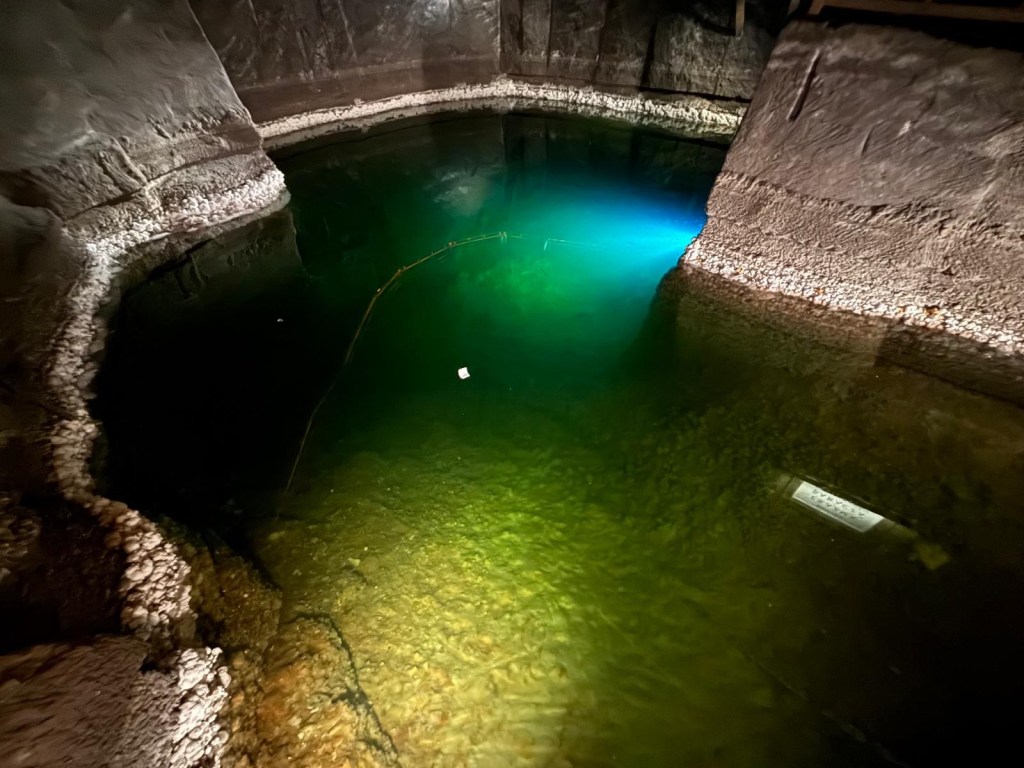
sculptures made of salt, even a full-blown church,

a restaurant, and a souvenir shop. At its peak more than 2,000 people worked in the mine. I guess having a good salt mine in the neighborhood probably contributed to the wealth of Krakow.


It was cool to go to the mine – both literally and figuratively – but I also want to talk about the bike ride from Krakow to and from the mine. Terrible. Disjointed and not fun.
It was another bike path situation. Here’s the thing . . . These after-the-fact bike paths are frequently unpleasant. Bike on one side of the road for 400 feet, then cross over all the traffic and the trams and stuff, and bike on the other side. Bike there for 500 feet, then wander into a neighborhood for another half mile. Now take a bridge back over the road, figure out how to connect in an awkward way, and keep going on a narrow path. Then throw in a few staircases for good measure. Uff dah!
Not an uplifting topic, but we did try to visit the Auschwitz/Birkenau complex. Or, rather, we did visit the complex, but we couldn’t tour the grounds. We didn’t realize how strictly they control the flow of people, and because we arrived on a Saturday in the summer it was probably a peak day for visitors. After waiting for over an hour they told us that the only tour available was in another hour-and-a-half, and it was in Polish. With storms in the forecast, so we had to head to our campsite.

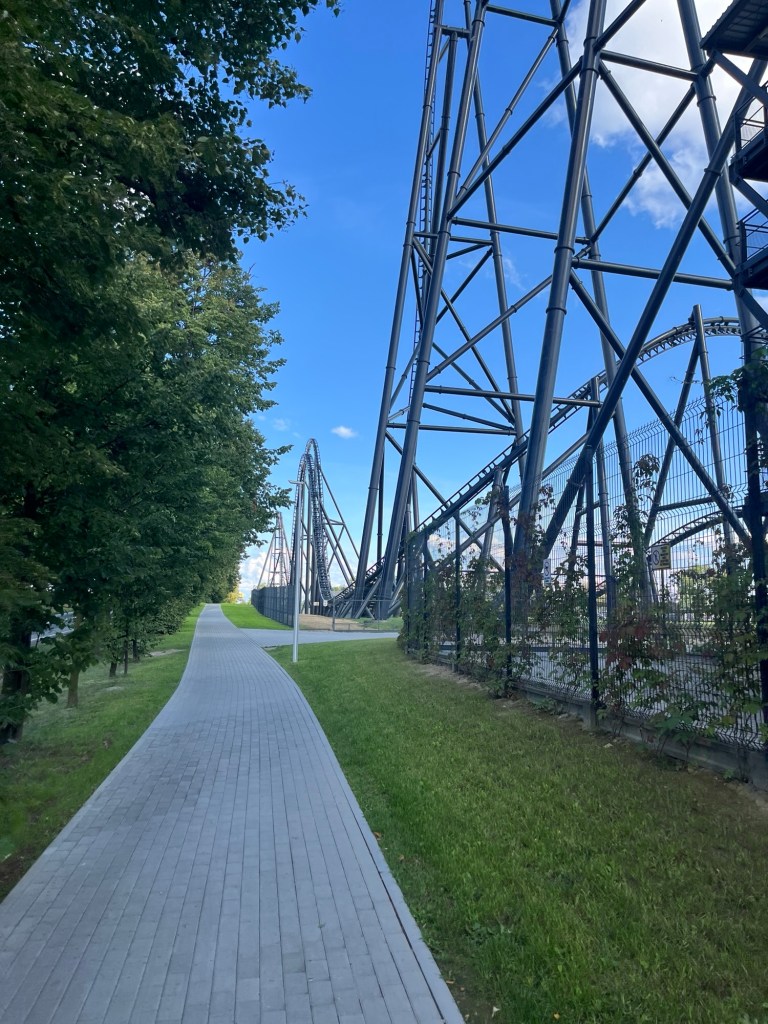
Still, we saw some of the barracks and it was pretty striking to see that the concentration camps were constructed right in population centers. Energy-landia – the biggest amusement park in Poland – is just a few miles away.
And there’s housing and shops just outside the gates. I guess people can get used to anything – but it just seems like it would be difficult to live right there – knowing what happened inside those walls.
There isn’t much to say on this topic other than it is depressing how cruel and horrible, and downright evil, people can be. It’s one thing to do something terrible in the heat of the moment. To systematically humiliate and kill that many people – including women and children … it’s unspeakable.
I don’t want to end a post on such a dark note, so I’ll finish by saying a little about Krakow. Another city we really enjoyed. Love the big public square – the biggest such square in Europe.
Love that Nicolas Copernicus was from Krakow. He’s one of my heroes; I’ve always enjoyed people like Copernicus – who had the courage to stand up to the longstanding orthodoxy of the time. The Vistula River, big old churches, and a big castle, the public transportation system, and the walkable nature of the place are also positives. Kind of amazing that Krakow survived World War II largely intact – just kind of the luck of the draw.

Tomorrow we head toward Warsaw. Let us know if you might have thoughts there . . .




Discover more from Diana & John's Biking Adventures
Subscribe to get the latest posts sent to your email.
 Diana & John's Biking Adventures
The problem with bike paths is “biking” is such a diverse activity. The beautiful Martin Sabo bridge over Hiawatha is great for training and keeping riders away from a busy road, but the stoplight at 28th is usually faster and less effort for a loaded bike commuter.
One of the best rides I get to do is all the crazy bridges around Wirth over towards Loring Park with 612middle schoolers on a rain day. I can’t figure out who really gets high use/benefit from a few of them but 30 kids with spotlights winding down the multi-level circular path is magical. The kids are all super executed at the weird way you can move about the city on a bike.
For almost any other biking in the area I do trying to get somewhere, I’ll just use a block or two of streets vs. a half-mile or more detour to access and climb these bridges.
Still glad some Mungers and Sabo’s and others helped get so much infrastructure in the state and still jealous how far we are from the Netherlands.
Eric sumner.
LikeLike
Eric: Good to hear from you! Great to hear that there are still so many kids getting out riding with amazing volunteers like you in Minneapolis. Looking forward to connecting – and maybe chatting on bike trails – over a bet on our return! Talk soon!
LikeLike
Thanks for the update, and great that you like Poland! Indeed, it was a punching bag for much of the last 300 years, but before then, Poland (or Poland-Lithuania) was the biggest country in Europe, holding sway over a huge swathe of territory from the Baltic down to the Black Sea, including much of present-day Ukraine. (Remember what I said about pretty much every people of this region having held sway over others at some time — and always harking back to that time of greatness? Well, it applies to the Poles as well!). There simply is no clean way to parse these different people and territories apart (and no need to) — far better to have the European Union that can be home to everyone.
btw, I have no idea how I became nightcrispy — but so I am. Bon voyage! Andreas
LikeLike
Dear Nightcrispy – I think WordPress assigns a random name to people. Not sure there is any rhyme or reason …
Yes, we are really enjoying Poland. Just so impressed by how amazing this country is doing given where it was just a short time ago.
Funny about all these countries always harkening back to their days of glory…
😁
LikeLike