Belfast, Northern Ireland
I don’t know about you, but we grew up in a time when we heard a lot about the IRA, Sinn Fein, bombings, hunger strikes, and whatnot – but we were young enough that we never really understood what the conflict was all about.
It was always portrayed as the Protestants and the Catholics. My impression had been that there were some Protestants in Northern Ireland, and they just didn’t get along with the Catholics. Kind of right – but not really . . .
Let’s back up.
The English – or some version of them – first conquered Ireland in the twelfth century. In the early-seventeenth century, King James I started the Ulster Plantation. The idea was to colonize Ulster – the northernmost of the then-four provinces of Ireland – with more loyal British subjects (English and Scots), and to promote Protestantism on the island generally.
To encourage people to go he promised them land and special privileges. Lots of English and Scots moved to Ulster, and by the early-19th century Ireland was about one-third British/Protestant. By this time many of the Irish/Catholics had left Ulster – I would say for greener pastures – except that in Ireland all the pastures appear to be pretty green . . .
Over the years, the Irish resisted British rule but their rebellions were generally handled fairly easily by the Crown. However, by the late-19th century, the Irish had finally gained some momentum, and in 1921 the British finally tired of the whole thing and allowed Ireland to have home rule.
But with one big proviso. The British/Protestant contingent in Ulster wanted no part of broader Ireland; they wanted to remain part of Great Britain. So while the British allowed for home rule in Ireland more broadly, they carved out a big part of Ulster and said that this new place – Northern Ireland – would remain part of Britain.
Now, you may be asking yourself why they didn’t just keep the name Ulster for this new entity. There’s a good reason for that. In order to ensure that the new state would be majority British/Protestant, they had to drop a few Ulster counties – that were still primarily Irish/Catholic. That’s why – when you look at the map – Northern Ireland does not include the western counties that are along the Atlantic.

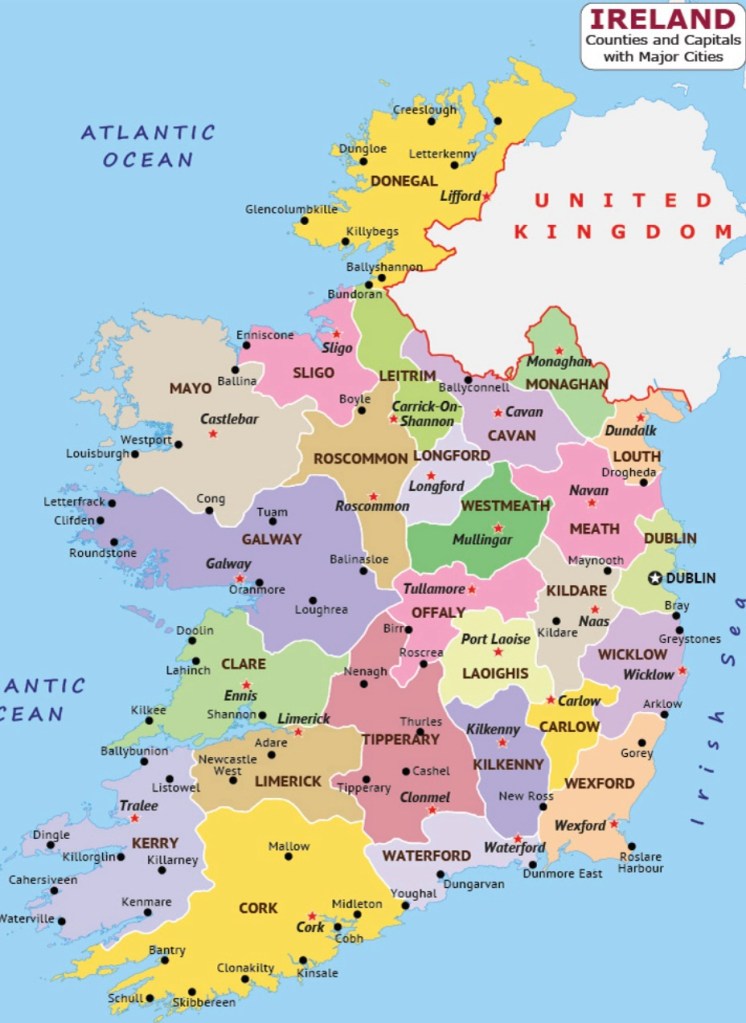
Okay – now that the table is set, we can talk more intelligently about how the troubles started. And this is where things start looking a lot like the American South under Jim Crow. The Brits were too “civilized” to explicitly discriminate at this point. So instead they proceeded with laws and practices that had a discriminatory effect – even if they were, on their face, neutral as between the Irish and the British. For instance, they gerrymandered political districts so that the Catholics were effectively disenfranchised. They used their old boys system to ensure that Catholics did not receive plum government jobs. They only hired Protestants into the police force. That type of thing . . .
Need to pause for a moment on our nomenclature. Pretty much everything is phrased in terms of Catholic/Protestant – but the real division is Irish/British. Those wanting home rule – or, at this point, to join the Republic – are on one side. Those wanting to stay under the British Crown – who are effectively all descendants of the British/Scots – on the other side. Upshot is that it is fair to describe the split either way: Irish/British or Catholic/Protestant.
Now, back to the story. After forty-plus years of mistreatment (really hundreds of years since the Protestants arrived – but forty-plus since Northern Ireland was formed) the Irish had had enough. When they saw what Martin Luther King was doing in America, they decided to emulate the Civil Rights protests. At first there were marches, but eventually things got ugly.
Another quick pause. By this time the Irish Republican Army – or IRA – had formed, a paramilitary group with the aim of ending the discrimination and, really, uniting with the Republic. On the other side, the Ulster Volunteer Army re-formed. (It was originally started in 1912 as a way to oppose the home rule movement of the early 20th century.)
I don’t know a lot of the details – but basically these paramilitary groups kept a steady stream of bombings and violence – terrorism, really – going until 1998, when they finally agreed to put down their weapons. The gist of that deal – the Good Friday Agreement – is that there would be power-sharing in the government, the paramilitary groups would need to disarm, political prisoners would be released, and Northern Ireland would be able to join the Republic if the majority of people wanted that.
So after all of that we finally arrive at the present moment. Yesterday we went on a “troubles” tour. We met at City Hall. The only indication of any of this in that area is that there is no flag – British or Irish – on the City Hall building. That’s because the flags have themselves been politicized. But, really, it’s not just that – we didn’t see any graffiti or banners or anything in the whole shopping district and in the university area.
The tour guide, Jess, a very self-possessed red-haired Irish Catholic, took us to the neighborhood that was at the center of the conflict: East and West Belfast – which are immediately adjacent to each other. What appears to be the working class Irish live on the West side and what appears to be the working class British on the East side. There are memorials and graffitied slogans all over the place. And on the east side there are British flags everywhere.

The alarming part is that there is a big wall – kind of how we would envision the Berlin Wall from years ago – between East and West Belfast. During the day, there are streets you can walk or drive back and forth on. But at night – from 6:30 p.m. to 8 a.m. – they close the gates across those streets. Now, you can still go way around to get from one side to the other – but otherwise things are closed off. I guess everyone feels safer that way.


The wall might make it seem like the tensions are still bad. But I think now it’s basically garden variety hate. Not much politics left. It’s pretty clear that Northern Ireland has a pretty short shelf life as a state (more on that later) – and once it becomes part of the Republic I would expect this nonsense to eventually fade away.

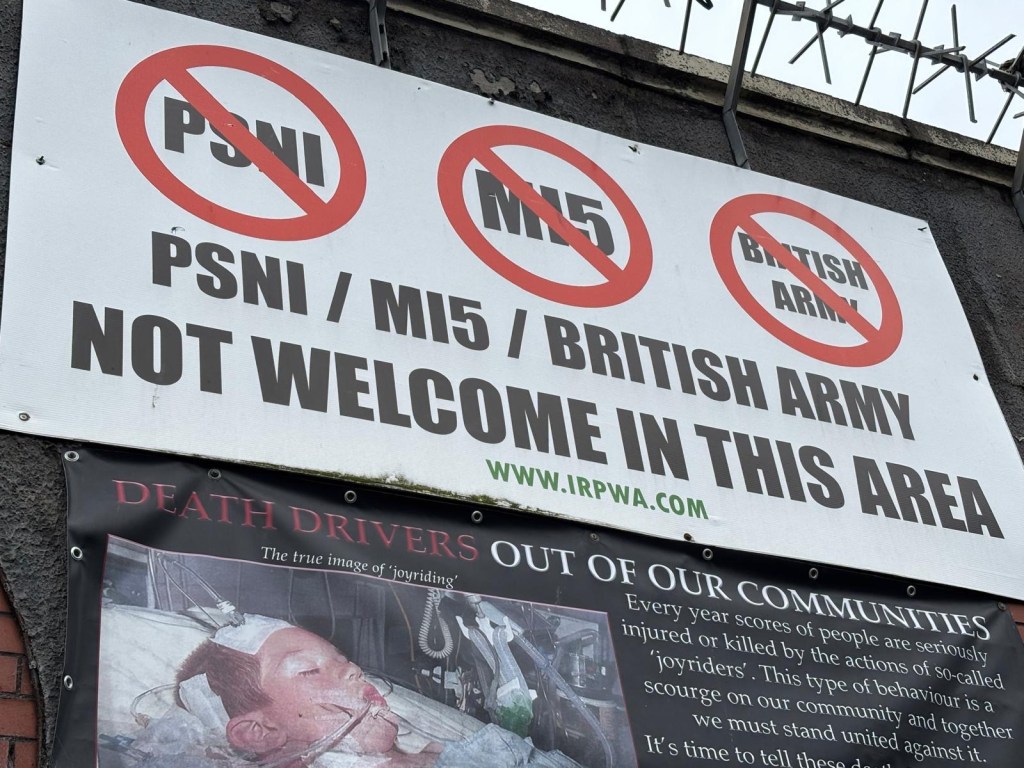
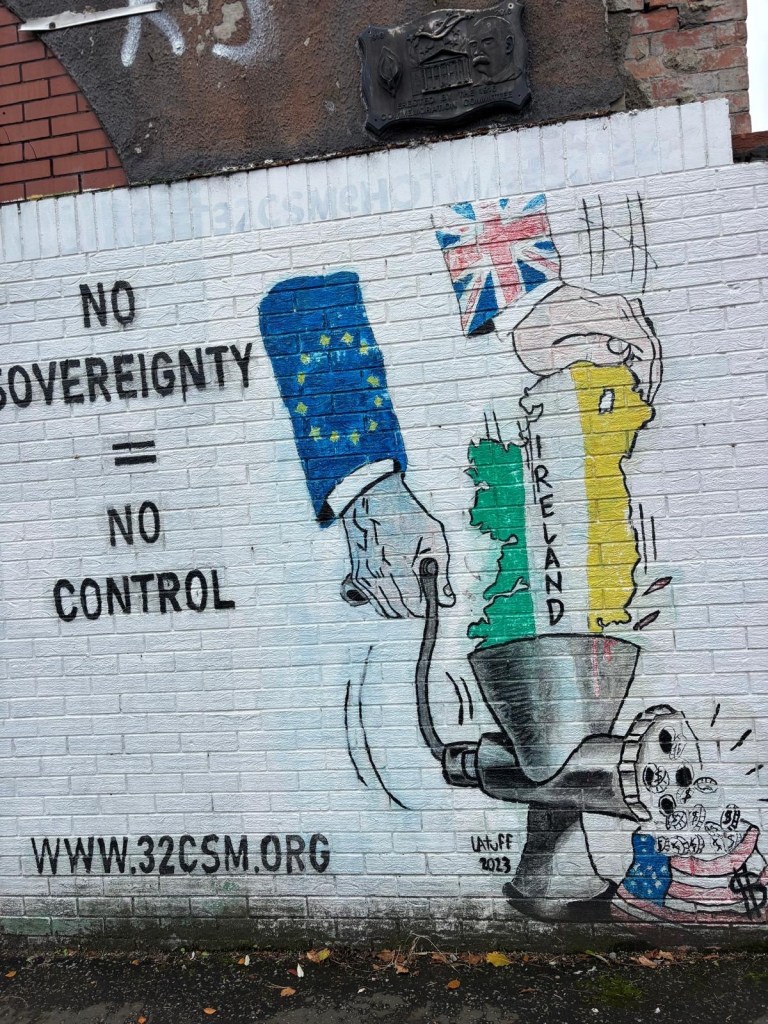
The funny thing is that there seems to be a growing population of immigrants in Ireland. I’m sure they look around and wonder what the fuss is all about . . .
The one other thing I’ll mention is the schools. They have what I think we in America would think is a pretty strange system. The schools are publicly funded, but there are essentially two parallel systems: the Catholic schools and the Protestant schools. Most people send their kids to the schools that match their “side,” but I guess there is a growing contingent of people who are sending their kids to integrated schools. Of course, both the Catholic and the Protestant clergy don’t love this idea – because these integrated schools mean less public support for the perpetuation of their own educational institutions.
One more great argument for the separation of church and state . . . What better way to perpetuate all this hatred than keeping the kids and families separated?
A little more analysis of the current state of affairs . . .
My sense is that all of the troubles are still so raw that people are going to be upset for a while. But history marchs on. And my understanding is that the demographic trends favor the Irish. I guess the Irish are moving in and having children and many of the Brits are moving away. The prevailing wisdom seems to indicate that there will be a referendum within the next ten years, and, at that point, Northern Ireland will likely be absorbed into the Republic.
Which probably explains why it feels like the British side seems more amped up about the whole split than the Irish. They’re basically clinging to the last vestiges of the power they once wielded.

An example is this is a fraternal organization they have – the Orangemen. They’re named after William of Orange – who was a Dutch guy who became king of England after deposing his father-in-law, who had been the king but was Catholic. Sounds like your typical hate group. They seem to have convinced themselves that the British/Protestants are somehow better – like genetically better – than the Irish/Catholics. Apparently every summer in July they have a big bonfire day where they burn Irish flags and other symbols of the Republic. And then the next day they all dress up in their uniforms and march around town with their British flags.
Real nice . . .
I’m sure the organge men (maybe our president should apply for admission – he has the right complexion anyway . . .) will go crazy when Northern Ireland joins the Republic – but what are they going to do?
Sorry for the long-winded diatribe. Lots to understand here . . .
But I do want to clarify one big thing. My sense is that Belfast is a pretty safe place these days. Especially for those of us who have nothing to do with the Irish/Catholic or British/Protestant split. Everyone we met was friendly and cordial.
Other than the one section of town – which you pretty much have to seek out – at this point Belfast just seems like a normal European city. I think we would give it two enthusiastic thumbs up.
On the ferry to Liverpool now. And, of course, now I’m not feeling good. We’re like a moving MASH unit these past few weeks…
Farewell dear Ireland! You may be cloudy and rainy, but we will always remember your verdant hills, your bleating sheep, your cheeky pubs, and your sunny people.



Discover more from Diana & John's Biking Adventures
Subscribe to get the latest posts sent to your email.
 Diana & John's Biking Adventures
Here two landmark films portraying the Northern Ireland difficulties. Michael Collins, an IRA rebel, is considered a hero after the Easter Rising in 1916 by many in the Irish Republic.
“Belfast”, made in 2022, speaks to the attacks on Catholics in 1969 from a family perspective
https://en.wikipedia.org/wiki/Michael_Collins_(film)
https://en.wikipedia.org/wiki/Belfast_(film)
LikeLike
Really enjoyed Michael Collins. Need to watch it again; feel like I would understand it more these days…
LikeLike